
How to Build Customer Trust in the Furniture Industry: A 2026 Marketing Strategy Guide

Adam Baodunnov
Furniture Marketing Strategy in 2026: Why Trust Is the New Conversion Rate
For years, trust has not been something people give away easily like a gift, and for a good amount of reasons: buyers now have more information, more alternatives, and more reasons to question what they see.
From a brand perspective, they must treat trust as a valuable asset that they earn, carefully evaluate, and continuously prove to shoppers since even a single online review can expose inconsistencies and trigger doubt, especially in a market where social proof strongly influences decisions. One poor experience can circulate quickly and damage one’s brand credibility.
This 2026, trust is no longer just a value. Furniture marketing strategy now relies on trust as the new conversion rate. In our previous blog, 6 Furniture Industry Outlook Trends for 2026, we identified trust as one of the measurable shifts shaping the industry.
Why Trust Is Important?
It’s easy and not hard to decipher. Let’s use a travel agency as an example. A travel agency does not lose travelers because its beaches are not beautiful or because the destinations are not worth visiting. It loses travelers because people do not believe what they are being shown, and they feel that the agency undervalues them. Travelers know exactly where they put their money.
The same applies to the furniture industry and this is where furniture marketing strategy must also evolve. Furniture brands do not lose customers simply because their prices are high or uncompetitive. They do not lose shoppers because their furniture lacks value. In most cases, they do not also lose them because there are no customers left.
They lose them because Australian buyers, and buyers everywhere have become more cautious and rely heavily on word of mouth. They no longer accept what they see at face value and their expectations are higher than the Q1 tower you can see.
When doubt enters their decision process, hesitation quickly follows. These doubts are your silent killers destroying demand faster than limited stock, high prices, or discount coupons ever could.
How Trust Directly Impacts Furniture Growth
Australia’s 2026 consumer insights report shows that growth in 2026 will come from relevance, relationship-led engagement and earned trust rather than volume or interruption-driven tactics. Australians are far more selective and have higher expectations around trust and control in digital experiences.
In addition, as highlighted in Resonate CX’s 2025 Australian purchase trends report, nearly three in four Australians (74%) say they’ve changed their shopping behaviour in the past 12 months as they prioritise value, cautious on what they spent, and more intentional on choosing. This reflects a high consideration mindset rather than impulsivity.
The Reality of How Australians Shop for Furniture:
- They don’t usually start with a brand; they start by identifying the problem to address such as the space, place, renovations, upgrades, and budget. After that, they identify what they want and what is their top priority.
- They research extensively before they commit to a brand and product. Australians compare multiple retailers, read reviews, check delivery terms, look at user photos, and, if there are showrooms, they make sure to visit—indicating that they don’t rush; they validate the truth you’re claiming.
- They screenshot, save, and shortlist. It’s an ongoing journey for Aussies. They save items on Instagram, screenshot products, compare furniture brands, leave, and come back. Unless they verify what they want, and that truth kills doubt—they won’t move forward.
- Aussies are value-conscious, especially under cost-of-living pressure. But remember, being the “cheapest” rarely wins outright. They still evaluate quality, materials, reviews, and warranties. This time, they want to feel the price is justified, not feel tricked by it.
- They fear regret more than they seek deals. The real question in their mind isn’t, “Is this 10% off?” It’s whether it will look good in their space, whether the product is comfortable, and whether what they receive matches what was promised. These hesitations are what your furniture marketing strategy should remove, because this is where brands lose them. If your strategy focuses only on promotions and traffic instead of reducing doubt and reinforcing trust, you’re optimising noise, not brand confidence.
- As part of Aussie behaviour, shoppers switch between online and offline. Even digitally confident buyers visit a store to touch and test. This behaviour is called webrooming, where customers research products online first and then go to a physical store to complete their purchase. It’s basically Research Online, Purchase Offline (ROPO), the reverse of showrooming, where people see products in store first and then buy them online.
- The hardest truth is that furniture shoppers don’t buy on the first visit. They go through multiple sessions and multiple validations before they purchase. If your furniture marketing strategy assumes fast conversion, you’re misaligned with reality.
Australian furniture buyers are not impulsive, and they are not irrational. They are deliberate. They move slowly because the purchase feels significant. They research because they want certainty. They compare because they want reassurance. They hesitate because they fear regret.
This is not a traffic problem. It is a confidence problem.
You make your brand too perfect, too polished, overpromised with little proof. So, if your furniture marketing strategy focuses only on driving visibility, promotions, and faster checkouts, you are solving the wrong issue. The real opportunity lies in removing doubt at every stage of the journey, before the showroom visit, before the discount code, and before the final click.
This 2026, growth will not belong to the loudest brands. It will belong to the brands that make decisions feel safe.
Furniture Marketing Strategy in 2026: How Furniture Brands Can Build Customer Trust
Brands struggle to admit that building trust is not about making their brand “perfect.” In fact, who wants perfect now when we don’t even know or see what perfect is? The more polished your creative looks, the less believable it often feels.
Australian buyers don’t hand over trust easily. Instead, they evaluate it. In 2026, the core of furniture marketing strategy is moving away from visibility-first to validation-first. Building trust is not about louder messaging. It’s about reducing doubt at every stage of the journey.
Here’s how disciplined brands should approach it:
1. Remove Uncertainty Before It Becomes Hesitation
Most brands wait for objections to surface. Disciplined brands expect them and act to pre-empt them. Most furniture buyers worry about size accuracy, material quality, colour consistency, delivery reliability, warranties, and comfort.
If you want to stand out among many furniture brands out there, your strategy should address each doubt they have by:
- Providing exact dimensions with room visualisers
- Showing real-life customer images, not only styled renders or AI-generated images
- Clarifying return policies in plain language
- Explaining materials transparently
- Setting realistic delivery expectations
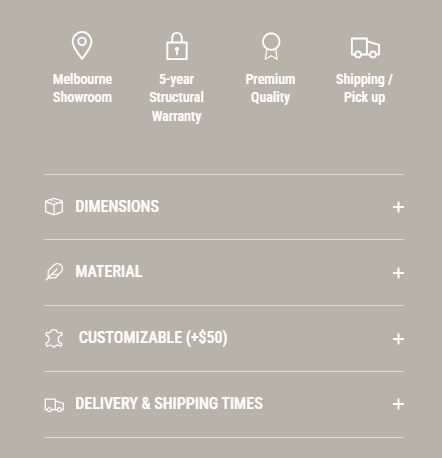
Remember, one way for customers to trust you is by building information that is complete and includes exact details. As a furniture brand owner, try to put yourself in a customer’s situation and ask what questions they are going to raise if they’re buying for you to understand their point of view.
2. Turn Product Pages into Confidence Hubs
In 2026, a furniture product page cannot function as a digital catalogue. It must function as a decision environment since furniture is a high-consideration purchase.
A disciplined furniture marketing strategy includes eliminating visual uncertainty by adding close-up material photos, different angles, user-generated photos in real homes, short product videos, and, if possible, a 360° view.
Next is by removing measurement ambiguity because size errors are one of the biggest sources of regret in furniture purchases. Adding clear dimensions in millimetres and centimetres, visual dimension overlays on images, room planner tools or AR placement, and blogs or guidance such as “best for small living rooms” or “ideal for apartments” builds customer trust, as you make the product more accessible through the information you share. Furthermore, the easier you make spatial validation, the faster buyers move forward.
Consequently, surface social proof strategically. Reviews are not just trust indicators; they are essential for other furniture shoppers to buy your product. The best practice is to show review ratings near the price. You can alongside highlight reviews mentioning comfort, delivery, and durability .
Moreover, you have to include customer-uploaded photos. Most importantly, address negative feedback with brand responses and don’t hide them because we all make mistakes, just don’t make it a habit. A buyer’s trust increases when buyers see real experiences, real feedback, and brands that stay accountable for their mistakes.
Additionally, clearly present delivery and returns without problems, as delivery and returns create major hesitation when shoppers are buying. For example, Mars Performance’s website clearly displays warranty policies and delivery timeframes upfront, reducing ambiguity before a customer even asks the question.
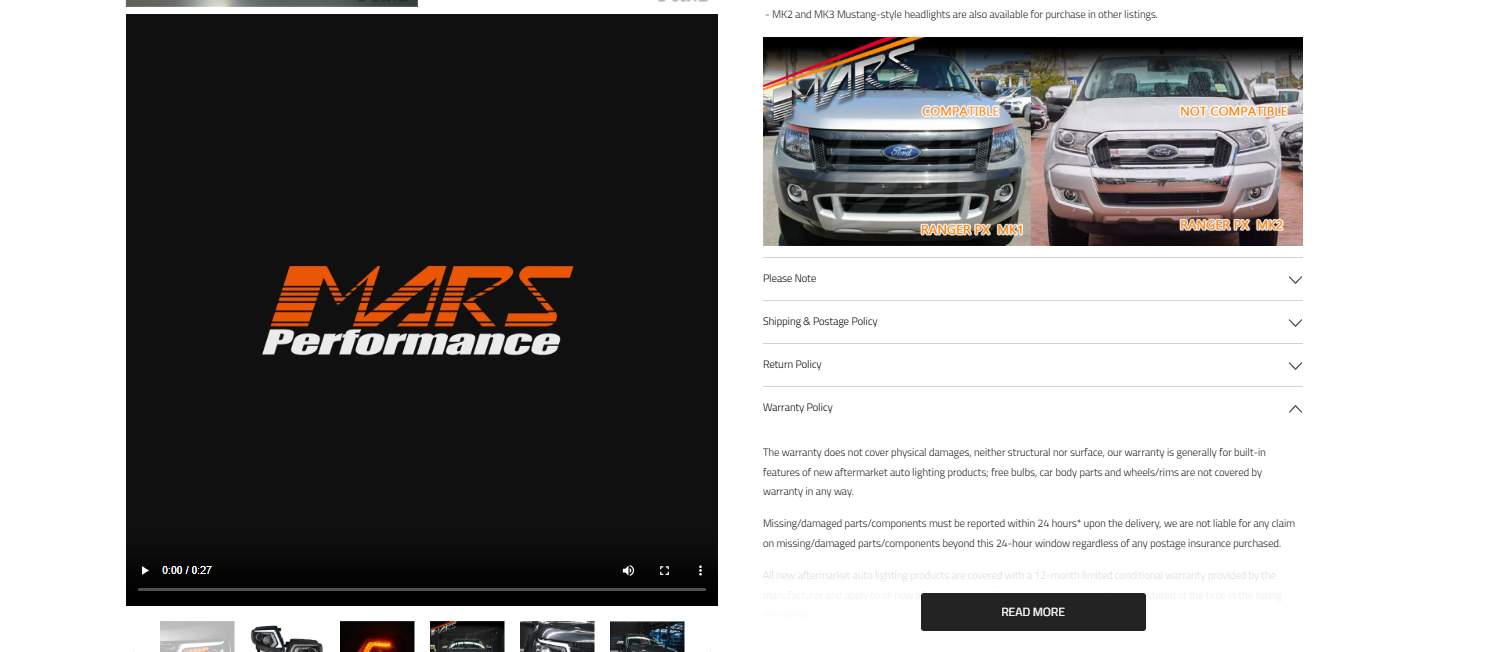
Your product page should clearly answer delivery timeframe, assembly requirements (DIY), return window, return cost (if any), and warranty terms. When buyers must click through three pages to find return details, they interpret it as a risk and a problem.
Next, you must reinforce value, not just price. In a cost-of-living environment, Australians evaluate justification. Instead of “Now $1,299 (was $1,499),” you can additionally explain what materials justify the price, longevity expectations, care instructions, and warranty length. Remember, price alone doesn’t build trust, but justified value does.
Lastly, you must reduce cognitive load by using a clear hierarchy, separating specs, reviews, and FAQs. In addition, avoid overwhelming pop-ups and keep calls-to-action consistent. If your website feels overwhelming, buyers postpone purchasing.
3. Align Online and Offline Experience
Consistency is the key, and this applies to all of your platforms, both online and offline, because webrooming is not a drag on a buyer’s customer journey; it’s behaviour. If buyers research online and validate in-store, your messaging must stay consistent across both. That means pricing alignment, sales staff reinforcing online messaging, and having seamless showroom-to-online checkout options. One inconsistency can make a buyer’s trust crumble faster than price differences.
4. Optimise for Confidence and Not Just Conversion Rate
Conversion rate is an outcome, but confidence is the driver. So instead of asking how you can improve clicks, you have to strategically evaluate your brand through your customer’s journey and review where hesitation starts, what questions remain unanswered, and what signals reduce regret.
You should measure them accordingly: return rates, review sentiment, time-to-decision, assisted conversions, and repeat purchase behaviour. These are trust signals and not a vanity metrics.
Why Furniture Brands Partner with LTBS
Understanding that trust drives conversion is one thing. Operationalising it across your entire growth system is another.
Most furniture brands don’t struggle because they lack traffic. They struggle because their growth architecture amplifies doubt instead of removing it. They invest in ads before aligning messaging. They push promotions before stabilising product confidence. They optimise conversion rates without diagnosing hesitation.
That’s where momentum stalls.
At LTBS, we don’t treat furniture marketing as a channel problem. We treat it as a structural growth system.
We help furniture brands:
- Diagnose where hesitation enters the customer journey
- Align product pages, messaging, and social proof with buyer expectations
- Strengthen trust signals before scaling paid media
- Reduce reliance on discount products
- Build validation-first strategies that compound over time
Because in a high-consideration category like furniture, scaling visibility without stabilising trust only exposes weaknesses faster.
Disciplined brands don’t grow by accident. They grow because their marketing system reinforces confidence at every touchpoint from first click to post-purchase experience.
We’re only a month into 2026, and if your growth feels heavier than it should, that’s not a failure. It’s a signal.
It signals that traffic is not the constraint. Trust is.
LTBS works with furniture brands at this stage, when the next phase of growth requires structural alignment, not louder campaigns. We help you identify what’s actually limiting momentum and realign your strategy around what drives sustainable demand.
Because in today’s furniture market, the brands that win aren’t the loudest.
They’re the most trusted.
Book a strategy call with LTBS and let’s uncover what’s holding your furniture brand back!