
The Furniture Industry Outlook for 2026: Why Disciplined Brands Will Win

Adam Baodunnov

6 Reasons to Be Optimistic About the Furniture Industry in 2026
After years of inflation pressure, rising freight costs, volatile demand, and increasingly expensive paid media, the furniture industry is stabilising. The furniture industry outlook for 2026 isn’t hype, it’s structural opportunity.
2026 presents a genuine opportunity for Australian furniture brands, not because the market will magically become easier, but because it’s becoming clearer. More stable. More measurable. More operational.
In other words: 2026 won’t be a boom year. It’ll be a precision year.
Why 2026 Will Reward Disciplined Furniture Brands
Precision is good news, because it rewards brands that operate with clarity and discipline.
As the sector is poised for steady expansion projected to reach roughly AUD 29.4 billion by 2033, and forward-thinking furniture brands have many reasons to feel confident about the road ahead.
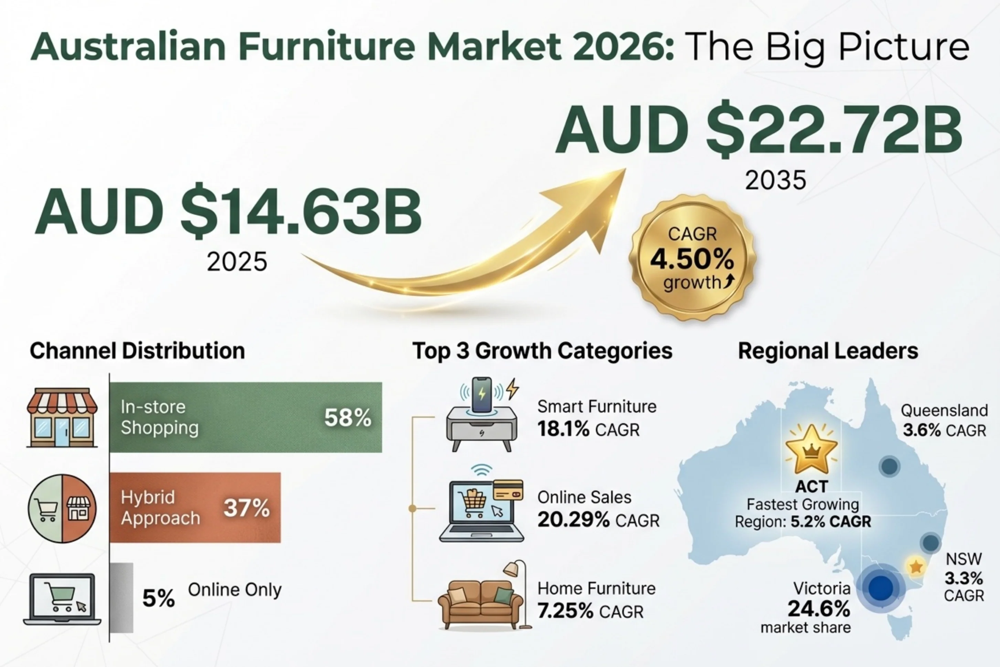
At LTBS, we work closely with furniture brands navigating this shift. The ones that win aren’t chasing every new platform, trend, or SKU. They’re tightening their fundamentals: positioning, merchandising, conversion, and trust.
6 Furniture Industry Outlook Trends for 2026
1. Demand Normalisation Signals Steady Growth
After a period of extreme highs and lows, demand for furniture is normalising to a healthy baseline. The pandemic saw a surge in home furnishing purchases followed by a slowdown, but the latest data show the industry returning to modest growth. In Australia, furniture retail sales reached AUD 12.6 billion in 2025, up 0.5% from the previous year.
Volatility is expensive. So, when demand spikes unpredictably, brands overstock. When demand drops, they discount. Then marketing gets blamed. Then the cycle repeats.
But as consumer behaviour stabilises, something important happens: planning becomes possible again.
Normalised demand enables:
- more accurate inventory forecasting
- better supplier negotiation
- less discount dependency
- cleaner marketing performance signals
Once demand becomes predictable, growth stops being a gamble and starts becoming an operational advantage. A market that is “evolving, not slowing” means furniture businesses can move forward with measured confidence in 2026.
2. Efficient Operations Boost Profitability
Furniture has never been a “cheap traffic” category. But over the last 24 months, the market has become ruthless: CAC increased, attention dropped, and conversions became harder to earn.
During the toughest years, many furniture businesses tightened their belts, improved their systems, and learned to operate lean. Those hard-earned efficiencies now create a real competitive advantage.
Brands that streamline operations protect margin while competitors burn budget. This environment punishes waste, and it rewards businesses that run efficiently, forecast accurately, and execute with discipline.
Manufacturers have also modernised production. Many have adopted lean practices and new technologies to become more agile and cost-effective. Across the industry, businesses now use automation and AI to improve output, reduce bottlenecks, and eliminate repetitive tasks.
Smart factories now integrate robotics, supply chain optimisation, and real-time analytics to shorten lead times, reduce downtime, and lower operational costs, helping brands respond faster to shifting market conditions.
In 2026, the winning brands won’t be the ones spending the most. They’ll be the ones that build a system around performance, including:
- strong merchandising
- clean collection structure
- clear product hierarchy
- high-performing product pages (PDPs)
- tight conversion paths
smart bundling and AOV strategy
This is where the industry is heading: efficiency as brand power.
At LTBS, we often see a painful truth: many furniture brands don’t have a traffic problem, they have a conversion problem. Brands heavily invest in ads, SEO, and social content to drive sessions, but they lose customers in the final metres because the shopping experience doesn’t do enough to build confidence. And in furniture, confidence is everything.
That’s why conversion issues show up in predictable ways across the category:
- product pages that look good but don’t answer buyer questions
- unclear delivery timelines and fees, especially by state
- weak trust signals means no reviews, UGC, and warranty visibility
- poor collection structure that overwhelms shoppers
- too many similar products competing for attention
- slow mobile load speeds and clunky checkout flows
In other words: brands drive traffic into a leaky bucket.
This is why efficiency compounds in 2026. A small lift in conversion rate, average order value (AOV), and return rate can outperform massive increases in ad spend because it improves profitability at every stage of the funnel. Furniture brands that audit their website and customer journey don’t win by buying more attention—they win by earning more revenue from the attention they already have.
3. Trust Has Become Measurable
For years, “trust” sat in the branding bucket, it’s hard to measure and even harder to justify. However, that’s no longer true.
Today, trust shows up clearly in performance metrics, including higher conversion rates, higher AOV, fewer returns, lower price sensitivity, stronger repeat purchase behaviour, more branded search demand, and stronger referral-driven growth.
In furniture, trust matters more than almost any other category because the purchase carries higher value, higher emotional commitment, and higher risk—from delivery damage to product mismatch and buyer’s remorse.
In 2026, trust-building won’t be “nice to have.” It will be the strategy. Brands build trust through:
- transparent delivery timelines
- accurate product photography, including UGC
- clear material and care details
- strong warranty messaging
- visible reviews paired with a strong post-purchase experience
- customer-first service design
Trust now acts as a performance lever. Brands that treat trust like an operating system will outperform brands that treat it like a campaign.
4. Evolving Consumer Expectations Create New Opportunities
Consumer tastes in home furnishings have evolved dramatically in recent years, and that evolution opens up opportunities for brands ready to meet new expectations. Australian consumers in 2026 are more informed, discerning, and value-driven in their furniture purchases.
The good news is that they’re willing to invest in quality and functionality like never before, as long as it aligns with their values and lifestyle. The furniture boom of 2020–2021 taught people the importance of loving their living spaces, and now a “flight to quality” is underway.
Homeowners would rather buy one great sofa that lasts than replace a cheap one every couple of years. Australians are increasingly investing in their living spaces for quality, functionality, and sustainability—a trend that favours brands offering durable, well-designed pieces.
Buyer expectations have changed and created space for better brands, which is a good thing. Educated buyers don’t just buy “cheap.” They buy confidence. Brands create confidence when they communicate clearly:
- what makes this product better
- why it’s priced this way
- what the delivery experience will be like
- what happens if something goes wrong
Furniture brands that still rely on generic positioning like “modern,” “luxury,” “affordable,” and “premium” will struggle. However, brands with a distinct point of view will win.
Additionally, one major shift is the expectation of sustainability and ethical production. Today’s furniture buyers, especially millennials and Gen Z, care about where materials come from and the environmental footprint. Many will pay extra for eco-friendly furniture, so brands that deliver on this can gain pricing power and loyalty.
The shopping experience matters too. The line between online and in-store has blurred: shoppers want the convenience of digital and the tangibility of physical retail.
Rising expectations aren’t a threat when brands can meet them—they’re an opportunity. Brands that deliver superior product quality, sustainability, personalisation, and a great purchase experience stand to earn loyalty and long-term value in 2026.
5. Digital Transformation is Unlocking New Growth Channels
Over the past few years, traditional furniture businesses have embraced e-commerce and data-driven marketing out of necessity. Now, those investments are paying off. Online channels are opening new markets and revenue streams that simply didn’t exist at this scale before.
The shift is not just about channel adoption, it reflects how Australians now discover, evaluate, and choose furniture online. Most consumers begin their journey on mobile or search, forming shortlists before they even visit a showroom, and increasingly make buying decisions based on visibility and information found before checkout, not after.
The numbers support this shift. The Australian online furniture market reached around USD $4.85 billion in 2024 and is projected to grow to $25.59 billion by 2033, roughly 20% compound annual growth. In other words, online furniture sales are growing far faster than traditional retail.
This growth creates a major advantage for brands that have strengthened their e-commerce operations, logistics, and digital marketing capabilities. Even if overall retail grows modestly, the digital share continues to expand, creating a clear path for outsized gains.
However, digital maturity isn’t just about having a website. It requires integrated omnichannel strategies and marketing that shows up where customers are actually discovering furniture brands: search, social, marketplaces, and connected content across the journey.
At the same time, brands are shifting from “more products” to “better merchandising.” Many furniture brands responded to competition by expanding their range:
- more SKUs
- more collections
- more categories
- more variations
The intention is understandable, more products should mean more customers. But the outcome often looks like the opposite:
- messy navigation
- weaker SEO performance (thin content + cannibalisation)
- confusing customer journeys
- inventory complexity
- marketing dilution
- higher discount reliance
In 2026, digital growth will also depend on better targeting and efficiency. Analytics now allow furniture brands to identify niche customer segments and personalise messaging at scale.
Temple & Webster, for example, grew revenue by 21% in FY2025 despite a tough retail climate, partly by leveraging its digital platform to capture a 2.7% market share in Australia.
More than 60% of its orders came from repeat buyers, and 75% of web traffic came via mobile, a strong indicator that its digital strategy built loyalty and repeat purchasing behaviour.
All of this reinforces a clear point: the digital transformation of furniture retail is already underway, and it enables scalable growth. Brands that continue to innovate online, through immersive AR shopping, efficient e-commerce operations, and data-driven marketing—have strong reasons to feel optimistic about expanding reach and sales in 2026.
The opportunity in 2026 is clear: the market is shifting away from endless choice and toward confident selection. The best brands will behave like curators, not catalogues.
6. The Experience Economy Is Reshaping How People Buy Furniture
Digital and trust aren’t separate shifts, they’re symptoms of a bigger change: buyers now expect a complete experience, not just a product.
In 2026, furniture purchases won’t be only about what customers buy, they’ll be about how customers feel while buying it. Today’s consumers don’t want to simply find furniture; they want to experience it before they commit. They expect seamless inspiration, discovery, comparison, reassurance, and fulfilment—whether online, in-store, or both.
This reflects how people now shop in high-value categories. They start with digital research, interact with immersive environments like AR previews or curated lookbooks, validate through peer social proof and reviews, and complete the purchase where they feel most confident. That journey rarely follows a straight line—it loops between channels, touchpoints, and formats.
Brands that design for experience unlock measurable business value. Experience-first strategies:
- shorten time to purchase
- increase conversion rates
- raise average order value (AOV)
- build repeat purchase behaviour
- strengthen loyalty and referral growth
This isn’t brand fluff. It’s measurable performance. Furniture brands that integrate online inspiration with real-world validation, virtual try-before-you-buy, lookbooks tied to shoppable PDPs, showroom appointment integrations—consistently outperform brands that treat channels in isolation.
In 2026, experience isn’t optional. It’s the competitive edge. Brands that deliver enjoyable, seamless, inspiring purchase journeys will lead the industry and win long-term customer value.
What This Means for Furniture Brands in 2026
The furniture industry isn’t heading into a hype cycle, it’s heading into a more disciplined phase. After years of volatility, the market is becoming more stable, more measurable, and more operational. That’s exactly why 2026 presents a real opportunity.
But the upside won’t reward brands that simply do more. It will reward brands that do the right things consistently: tighten efficiency, strengthen trust, simplify merchandising, modernise digital execution, and design a buying experience that matches how Australians actually shop today.
In other words, 2026 won’t reward noise. It will reward clarity.
At LTBS, we partner with furniture brands that have moved beyond experimentation and are ready to scale with structure. As a digital marketing agency in Melbourne, we provide digital marketing services in Australia that help furniture brands build profitable growth systems, not just campaigns.
If you’re serious about growth in 2026, the next step isn’t spending more, it’s auditing what’s already in place:
- where conversion leaks happen
- what’s weakening trust
- what’s diluting merchandising performance
- which channels actually drive profitable demand
If there’s alignment, we’re open to a strategic discussion. Let’s pressure-test your 2026 growth plan and build a system that scales profitably.