
AI Search for Ecommerce: How to Optimise Ecommerce Product Pages for AI Search

Adam Baodunnov
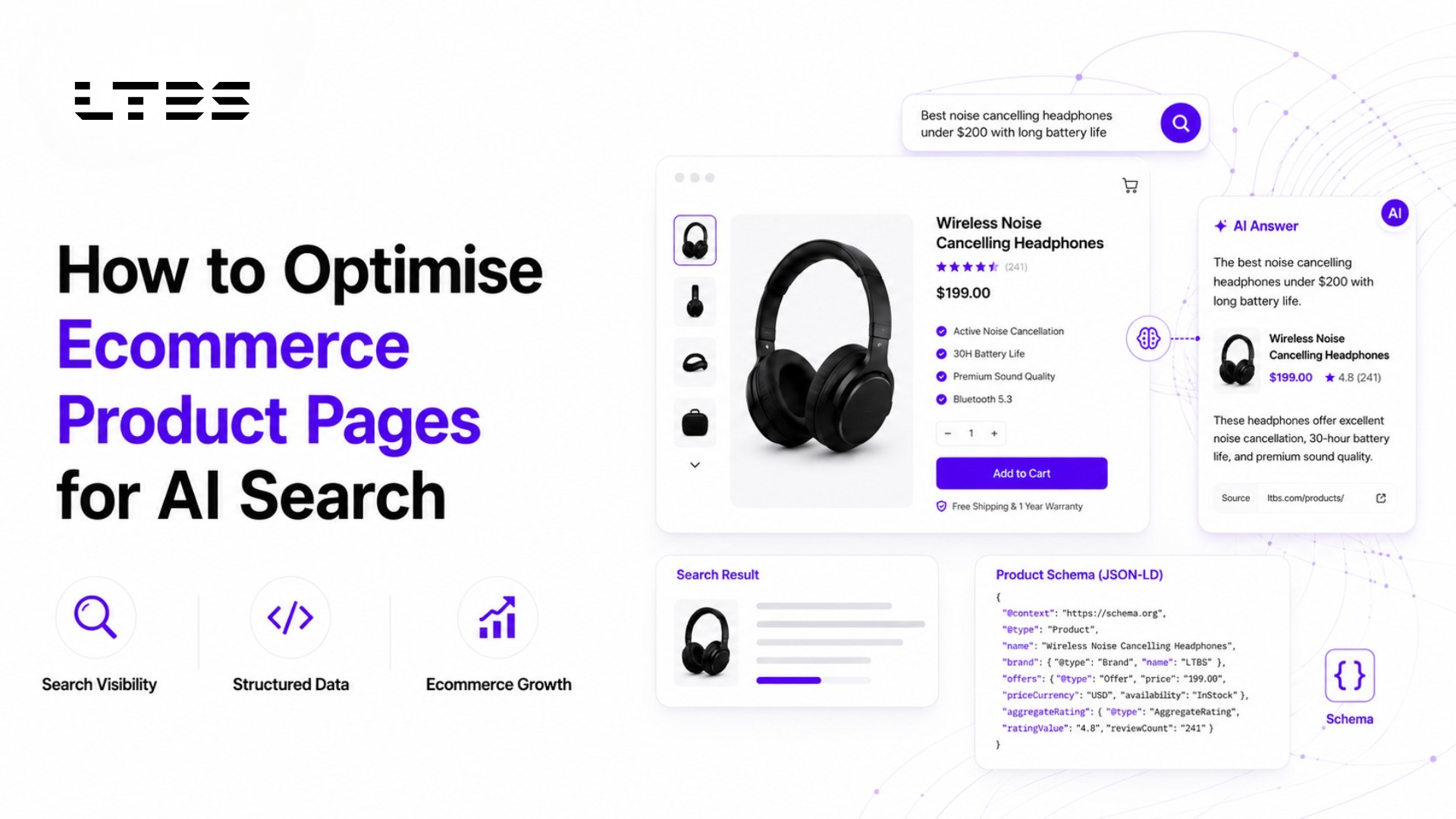
Search is going through its biggest shift since mobile. For two decades, ecommerce SEO meant one thing: rank a product page on Google, get the click, make the sale. However, that model is breaking down because of AI search for ecommerce.
Shoppers are increasingly asking ChatGPT, Google AI Mode, Perplexity, and Gemini to find, compare, and recommend products for them, and those tools don't hand back ten blue links. They summarise, synthesise, and pick winners.
As artificial intelligence reshapes the way people discover products online, ecommerce businesses face a new challenge: how to ensure their product pages are visible not only in traditional search engines but also in AI-powered search experiences.
In this guide, we will explain how to make your ecommerce product pages visible to AI Search by combining strong ecommerce product page SEO, structured data, high-quality content, and modern AI search optimisation strategies.
You'll learn how AI interprets product information, what makes AI-friendly product pages, and the practical steps you can take to improve your visibility across today's AI-powered shopping experiences.
What Is AI Search?
But first, what is AI Search? AI Search refers to a class of tools like Google AI Mode and AI Overviews, ChatGPT, Perplexity, Gemini, Microsoft Copilot, that generate a direct and synthesised answer instead of a results page. Instead of “here are ten links,” the response is “here’s the answer, and here’s what I’d recommend,” often with two or three cited sources rather than dozens.
How AI Search Is Changing Online Shopping
As we have mentioned, modern AI search tools generate conversational answers that summarise products, compare options, and recommend suitable items based on a shopper's needs.
The shift shows up in a few concrete ways too:
1. AI-generated Product Recommendations:
Rather than browsing category pages, shoppers ask a direct question such as “best waterproof hiking boots for winter”, and then they get a shortlist of answers with reasoning attached.
2. Conversational Shopping Experiences:
Follow-up questions, comparisons, and refinements happen in a chat thread rather than through filters and facets.
3. Fewer Traditional Search Result Clicks:
As Google continues expanding AI-generated search experiences, users are increasingly getting answers directly on the results page instead of clicking through to websites. Independent studies have consistently found that queries displaying AI Overviews receive significantly lower organic click-through rates than traditional search results.
For example, Seer Interactive's analysis of Google Search Console data found that organic CTR on queries with AI Overviews fell from 1.41% to 0.64% year over year, highlighting the growing importance of being cited within AI-generated answers rather than relying solely on conventional rankings.
4. AI Acting As A Shopping Assistant:
ChatGPT has become one of the world's most widely adopted generative AI platforms, with OpenAI reporting continued growth across regions, age groups, and workplace use. As consumers increasingly rely on AI to research products, compare options, and receive personalised recommendations, ecommerce businesses need product pages that AI systems can easily interpret and reference.
Traditional SEO vs AI Search Optimisation
Traditional SEO focuses on helping webpages rank for relevant keywords in search engine results pages. Success is often measured by rankings, impressions, and clicks.
Meanwhile, an AI search optimisation, sometimes referred to as Generative Engine Optimisation (GEO), expands this goal. Rather than simply ranking highly, businesses now aim to become reliable sources that AI systems reference when generating answers.
The differences are significant:
- Traditional SEO prioritises keyword relevance and backlinks;
- AI search focuses on semantic understanding, context, and factual accuracy;
- Search engines rank webpages;
- AI models interpret entities, relationships, and structured information before generating responses.
The foundational Generative Engine Optimization (GEO) study presented at the ACM SIGKDD Conference 2024 found that strategically improving content for generative search, including adding citations, quotations, statistics, and other credibility-enhancing elements improved a webpage's visibility in AI-generated responses by up to 40%.
Furthermore, the researchers also found that the effectiveness of these optimisation techniques varied across industries, reinforcing the importance of creating structured, trustworthy, and domain-specific content.
However, this doesn't mean traditional SEO is obsolete. Instead, it forms the foundation upon which AI visibility is built.
Why Ecommerce Stores Need to Adapt Now
Consumer expectations are evolving rapidly. Shoppers increasingly expect AI to answer questions, compare products, and recommend suitable purchases without requiring them to browse dozens of websites.
At the same time, Google continues integrating AI into Search, making product information more important than ever. Google's own Search Central documentation encourages merchants to provide comprehensive product data, structured markup, and accurate information so its systems can better understand products.
Businesses that invest in AI search for ecommerce today are preparing for a future where AI-assisted shopping becomes a standard part of the customer journey. Those relying solely on keyword rankings risk losing visibility as AI-generated recommendations become more common.
How AI Search Engines Read Ecommerce Product Pages
Understanding how AI interprets product pages is the first step towards improving visibility.
Unlike traditional search engines that primarily match keywords, modern AI systems analyse meaning, relationships, and context across an entire page.
AI Looks Beyond Keywords
Many businesses still believe repeating keywords throughout a product description improves visibility. While relevant keywords remain important, AI evaluates far more than keyword frequency.
When analysing a product page, AI considers information such as:
- Product specifications
- Materials
- Features
- Benefits
- Intended users
- Compatible products
- Common use cases
- Customer intent
- Pricing information
- Reviews and ratings
It is simple, AI models extract and reason over facts, that’s also why your product pages are your new landing pages since a comprehensive description explaining that the chair supports remote workers, offers adjustable lumbar support, breathable mesh, and suits users sitting for eight-hour workdays gives AI considerably richer information to interpret.
Remember, the more complete your product information, the easier it becomes for AI systems to understand precisely what you're selling.
Context Is More Important Than Keyword Density
AI systems rely on natural language processing, entity recognition, and semantic relationships to decide what a page is actually about and how relevant it is to a query.
A page that clearly establishes what a product is, who makes it, what category it belongs to, and how it relates to other products in your catalogue gives an AI model a much stronger basis for extraction than one relying on repeated keyword phrases.
Why Clear Product Information Improves AI Visibility
Having a complete product descriptions, accurate specifications, well-organised content, and consistent terminology across your catalogue all reduce the ambiguity an AI system has to resolve.
Recent research suggests that AI citation is driven less by isolated technical tactics and more by the overall quality, relevance, and authority of a page. A 2026 cross-platform study analysing 730 AI citations from ChatGPT and Gemini across 1,006 webpages found that Google organic ranking position remained the strongest predictor of AI citation, while standalone schema markup was not a reliable predictor on its own.
Those findings align with a broader observational study across ChatGPT, Claude, Gemini, and Perplexity, which concluded that query intent and organic search ranking are among the strongest predictors of whether a page is cited by AI systems, reinforcing that traditional SEO fundamentals still underpin AI visibility.
Industry research points in the same direction. An analysis of 16,851 queries found that the highest-ranking search result was cited by ChatGPT 58.4% of the time, and pages whose headings closely matched the user's query outperformed broader with much less focused content.
Essential Elements of an AI-Friendly Ecommerce Product Page
Creating an AI-friendly product pages is no longer just about appealing to human shoppers. Your product pages must also be structured in a way that AI search engines can easily understand, interpret, and reference.
Google's Search Central documentation has long encouraged merchants to provide complete, accurate, and helpful product information for users. Those same best practices now play an even greater role in AI search optimisation, where generative AI systems evaluate product pages based on their clarity, completeness, and credibility rather than keywords alone.
Remember, turning a standard listing into an AI-friendly product page starts with the content itself.
Write Descriptions That Answer Customer Questions
The best product descriptions do more than describe a product, they answer the questions customers are already asking. AI models tend to extract and cite content that resolves a question completely in a self-contained passage, so avoid descriptions that assume the reader already knows context from elsewhere on the site.
The richer description provides valuable context for both shoppers and AI systems.
Include Comprehensive Product Specifications
Specifications provide structured facts that AI systems can easily interpret. Dimensions, weight, colours, materials, warranty terms, and technical information all give AI systems concrete, extractable facts.
On the other hand, a generic manufacturer blurb with no measurements or materials listed leaves an AI model with nothing specific to quote, and nothing specific is exactly what won’t get cited over a competitor’s more detailed listing.
Use Clear Product Titles
Your product title is often the first piece of information AI systems analyse. Make sure to use effective titles that typically follow a predictable structure: brand, product type, model, and the attributes that matter most for that category.
One analysis of Google Shopping data found that restructuring product titles to front-load high-intent attributes improved impression share by 15–30% within two weeks, without any change in bid strategy.
Avoid keyword stuffing, a title crammed with every synonym you can think of reads as noise to both shoppers and AI parsers.
Optimise Product Images
Although AI primarily analyses text, images increasingly contribute to product understanding through computer vision technologies.
Descriptive filenames, meaningful alt text, multiple angles, and lifestyle imagery all support AI image recognition, which increasingly factors into how visual and multimodal AI systems evaluate a listing.
As AI shopping surfaces incorporate more visual search and recommendation features, images that are labelled and described accurately become part of your machine-readable footprint, not just a conversion-rate lever for human shoppers.
For example:
- Poor filename: IMG_4588.jpg
- Better filename: ford-ranger-px3-cold-air-intake-kit.jpg
Similarly, this also goes to your alt text, it should describe the image rather than simply repeat keywords.
Add Structured Data (Product Schema Markup)
Product schema markup is implemented as JSON-LD, it explicitly labels price, availability, ratings, and brand so AI systems don’t have to infer them from prose. The essential types for structured data for ecommerce are Product, Offer, Review, AggregateRating, Brand, Breadcrumb, and Organisation. Google’s own documentation states that structured data gives its systems a reliable way to understand product attributes at scale.
That said, be realistic about what schema can and can’t do on its own. Independent research, including an Ahrefs analysis of AI Overview citations, has found that schema markup doesn’t reliably create new citations by itself, it works best layered on top of strong content and genuine site authority, not as a substitute for either. Treat schema as the technical foundation that makes your content easier to parse correctly, not a shortcut past writing that content well in the first place.
Answer Questions With FAQs
AI systems extract naturally from question-and-answer formats, because that’s structurally close to how a conversational AI tool composes its own response.
By adding an FAQ section covering shipping, returns, compatibility, materials, installation, and warranty, the exact questions that would otherwise generate a support ticket.
Phrase the questions the way a shopper would actually ask them (“Will this fit a 15-inch laptop?” rather than “Compatibility Information”) so the format lines up with real conversational queries.
Build Trust Signals That AI Can Recognize
AI systems don't simply look for product information, they also evaluate whether the information appears trustworthy.
While Google hasn't published an "AI ranking checklist," its guidance consistently emphasises creating content that demonstrates Experience, Expertise, Authoritativeness, and Trustworthiness (E-E-A-T). Those same signals help AI determine whether a product page is reliable enough to reference.
Customer reviews are particularly valuable because they provide real-world context that complements your product descriptions.
For example, if multiple verified customers mention that a camping tent performed well during heavy rain, AI gains additional confidence that the product is suitable for wet-weather camping.
Similarly, trust pages such as Shipping, Returns, Privacy Policy, and About Us help establish business legitimacy. While these pages may not directly influence product rankings, they contribute to your site's overall credibility.
The goal is simple: make it easy for both shoppers and AI systems to trust your business.
Connect Related Products with Internal Links
Most ecommerce businesses think of internal linking as an SEO tactic. In reality, it's also an important way to help AI understand how products relate to one another.
Link related products, build buying guides, and connect categories and collections together. This internal linking gives AI systems a clearer map of how your catalogue fits together from substitutes, accessories, and bundles, rather than treating each page in isolation.
A buying guide like “How to choose a hiking boot for winter conditions” that links out to specific product pages also gives an AI system a natural, citable path from a broad conversational query down to an individual product.
Keep Product Information Updated
AI search engines prioritise accurate information. Outdated pricing, discontinued products, incorrect stock levels, or obsolete specifications can reduce confidence in your website.
Make sure to keep availability, pricing, images, and variant data current across every channel, a discontinued product left live with a broken purchase path is exactly the kind of gap that gets a listing skipped in favour of a cleaner competitor.
The Future of AI Search Starts with Better Product Pages
AI search isn't replacing traditional SEO, it's changing how search engines and AI assistants evaluate content.
Instead of focusing solely on rankings, businesses now need to create product pages that AI systems can understand, trust, and confidently recommend.
As we explain in AEO for Ecommerce Product Pages: Why Traditional SEO Isn't Enough in 2026, earning visibility in AI-powered search requires businesses to optimise for both search engines and answer engines. The same product page must satisfy human shoppers while also giving AI enough structured, trustworthy information to generate accurate recommendations.
Conclusion
As AI-powered search becomes a larger part of the ecommerce journey, visibility depends on far more than keyword rankings. AI systems favour product pages that are clear, comprehensive, accurate, and easy to interpret.
By writing original product descriptions, providing complete specifications, implementing structured data, answering customer questions, building trust through reviews and policies, strengthening internal links, and keeping product information up to date, you make it easier for both search engines and AI assistants to understand and recommend your products.
The fundamentals of ecommerce product page SEO still matter, but they're now complemented by AI search optimisation and Generative Engine Optimisation (GEO). Businesses that combine these approaches will be better positioned to earn visibility across traditional search results and the next generation of AI-powered shopping experiences.
If you're looking to strengthen your ecommerce visibility for the next generation of search, contact us now to learn how we can help optimise your product pages for both traditional SEO and AI search.