
AEO for Ecommerce Product Pages: Why Traditional SEO Isn't Enough in 2026

Adam Baodunnov
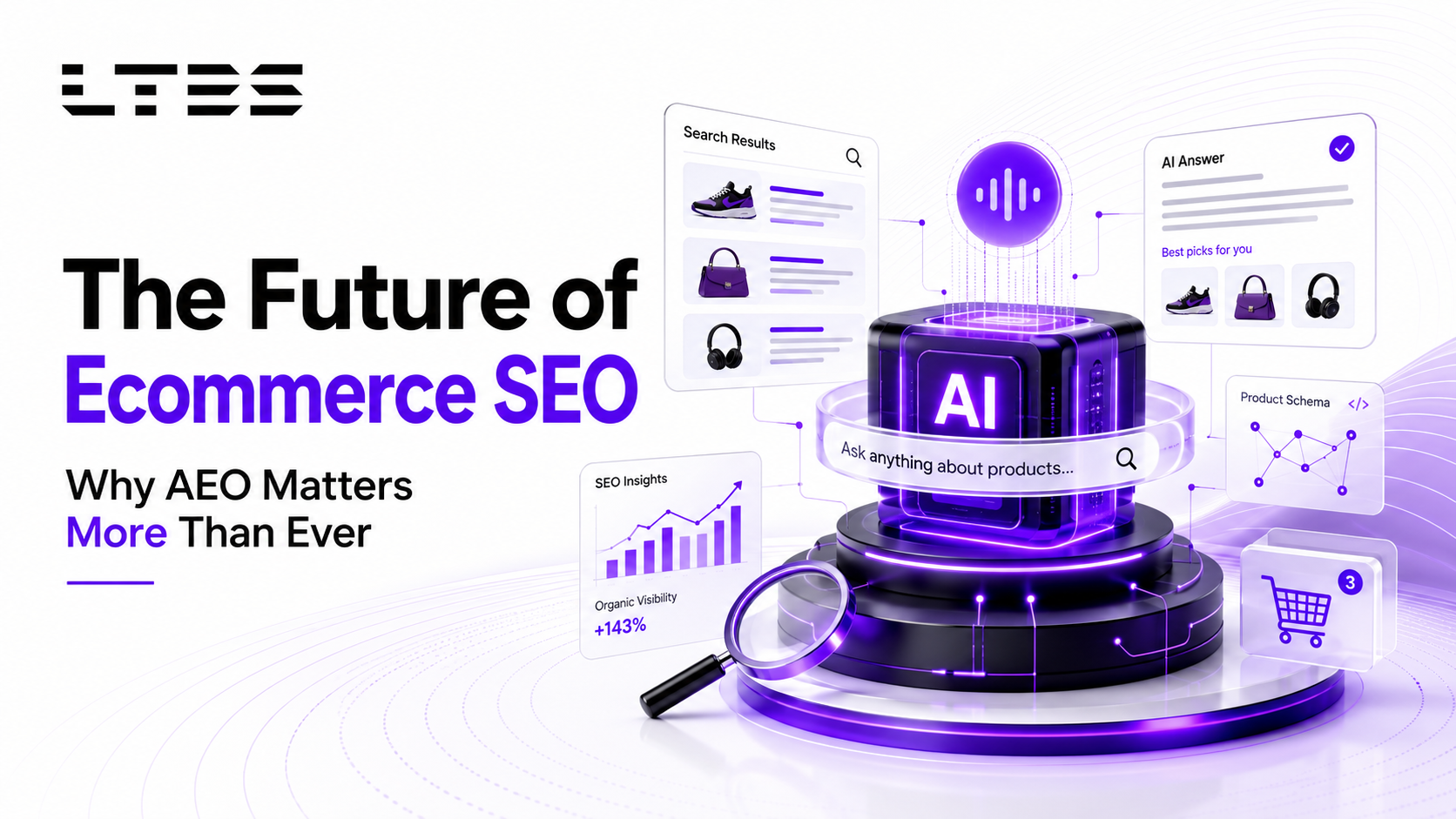
AEO.
SEO.
GEO.
LLMO.
If you sell online right now, you've probably seen all four acronyms thrown around in the same breath, sometimes in the same sentence, often with no explanation at all. It's easy to tune it out as more marketing jargon. But underneath the alphabet soup is a real shift in how people shop, and it's already changing which products get picked when a shopper asks an AI tool what to buy.
Let’s talk about the Answer Engine Optimization (AEO) that is changing how shoppers find and buy products online. Instead of scrolling through search results, people now ask AI tools like ChatGPT, Perplexity, and Google AI Overviews to just tell them what to buy.
And if your product page isn't built to be read and quoted by these systems, you're invisible at the exact moment a shopper is ready to purchase. This shift is not just a small update, it is a new layer sitting on top of everything ecommerce brands have spent years building through traditional search engine optimization (SEO).
What Is AEO?
Answer Engine Optimization is the practice of structuring your brand's content, product data, and reviews so AI systems can confidently pull them into a direct answer. Traditional SEO tries to earn a spot in a list of blue links. Meanwhile, AEO tries to earn a spot inside the answer itself, with no click required.
Why Are Product Pages Ground Zero?
Ecommerce is where this matters most, because shopping is one of the clearest use cases for AI answers. Shoppers aren't typing on Google “waterproof jacket" anymore. Instead, they're asking, "What's a good waterproof jacket under $200 for hiking in the rain?" and the average ChatGPT prompt runs about 23 words, compared to roughly 3 words for a typical Google search.
As you can see, it's a completely different kind of question, and it needs a completely different kind of answer.
Quick answer: AEO is the practice of structuring product content so AI engines like ChatGPT, Perplexity, and Google AI Overviews cite your brand directly in shopping answers, rather than just ranking your page in a list of links.
The stakes are real. Across 27,000-plus shopping-related AI queries studied by AEO researchers this year, products were cited directly in the answer roughly 38% of the time. For budget-focused questions like "best X under $Y," that citation rate jumped closer to 58%.
Meanwhile, half of consumers say they now use AI-powered search, and U.S. retail ecommerce sales hit $326.7 billion in the first quarter of 2026 alone, according to the U.S. Census Bureau. Every point of AI visibility is now tied to real revenue and not just impressions.
Why Traditional SEO Alone Is Losing Ground
Ranking #1 used to mean you won the click. That's no longer guaranteed.

Rankings don't always equal visibility anymore. Google's AI Overviews now show up in roughly a quarter of all searches, and instead of sending the shopper to your page, the AI reads a few sources, writes its own summary, and answers the question right there. Your page can rank first and still never get seen, because nowadays, AI decides its own summary and it's good enough from then on.
Keywords alone no longer carry a page. Older SEO rewarded pages that repeated a keyword enough times to signal relevance. AI systems don't work that way. They evaluate context and intent, such as what the page is actually saying, not just which words appear on it. A page can be keyword-perfect and still get skipped if it never actually answers the shopper's real question.
This is where a lot of ecommerce product pages fall apart, because so many were built for algorithms instead of people:
- Keyword stuffing that reads awkwardly and says very little.
- Thin descriptions with a couple of vague sentences and a bullet list of specs.
- Duplicate manufacturer copy, the exact same paragraph every other store selling the same product is also using.
Traditional SEO still matters for crawlability and rankings, but ranking well no longer guarantees visibility. AI Overviews summarize answers directly, and they favor pages that clearly answer a question in plain language over pages optimized purely for keywords.
AI engines actively prefer pages that read like a clear, direct answer to a real question. That single shift is the reason "why traditional SEO isn't enough anymore" isn't just a catchy headline, it's the practical reality product teams are running into right now. Our breakdown of SEO vs. SEM strategy covers this shift in more depth if you want the fuller picture of how search itself has changed.
How AI Actually Reads Ecommerce Product Pages
AEO is moving fast, freshness now decides who gets cited. According to Airops, roughly 83% of AI citations for commercial and comparison queries come from pages updated within the last 12 months.
Furthermore, AI systems don't scan a page the way Google's old crawlers did. They're not counting keywords or checking a meta title. They're trying to understand the product the way a person would if a friend asked, "Should I buy this?" Here's what AI models are actually looking for on a product page:
- Clear Product Purpose: what it is and who it's for;
- Specifications: the real and verifiable numbers;
- Benefits: what those specs actually mean in everyday terms;
- Comparisons:how it stacks up against similar options.
- FAQs: direct answers to the questions real buyers ask.
- Policies: shipping, returns, and warranty terms.
- Reviews and trust signals: genuine feedback from real customers.
- Structured data: the machine-readable version of all of the above.
AI models read ecommerce product pages by looking for clear purpose, specs, benefits, comparisons, FAQs, policies, and trust signals and not through meta titles, keyword density, or backlinks, which is what most product pages were originally built around.
The New Anatomy of an AI-Friendly Product Page
If traditional product pages were built to rank for search engines, today's product pages need to communicate clearly with both people and AI. Answer engines don't just scan for keywords, they evaluate whether a page provides complete, trustworthy, and well-structured information that directly answers a shopper's intent.
Here's what a modern, AI-friendly product page should include:
Start with a Clear Product Summary
Your opening paragraph should immediately tell both shoppers and AI what the product is, who it's designed for, and why someone would choose it. Instead of jumping straight into technical specifications or marketing buzzwords, answer three simple questions:
- Who is this product for?
- What is its main benefit?
- What problem does it solve?
For example, rather than writing: "Our latest ergonomic office chair features premium materials and an advanced lumbar support system."
Try something more informative: "Designed for remote workers and professionals who spend long hours at a desk, this ergonomic office chair provides all-day lumbar support to improve comfort and reduce back strain."
This gives AI clear context while helping customers quickly determine whether the product fits their needs. More importantly, AI answer engines can often distinguish between generic product copy and descriptions grounded in real experience. Details like how a product fits, how it performs over time, or what customers noticed after using it provide valuable context that AI is more likely to reference when generating answers.
As Anton, LTBS SEO Specialist in Shopify optimization and conversion strategy, explains: "AI engines can tell the difference between a product description written by someone who's actually used the product and one written by someone guessing from a spec sheet. Real usage details—such as how it fits, how it wears over time, and what surprised people—are the kinds of insights that get quoted back in AI answers."
Turn Features Into Benefits
Many ecommerce stores simply list specifications and expect customers to understand why they matter. AI and shoppers respond better when features are paired with real-world benefits. Instead of:
- Battery: 5000mAh
- IP68 Rating
- Aluminum Frame
Explain what those features actually mean:
- 5000mAh battery provides up to two full days of typical use without needing a recharge.
- IP68 water resistance protects the device from accidental spills and brief water exposure.
- Lightweight aluminum frames offer durability without adding unnecessary weight.
This approach transforms technical data into useful information that AI can surface when answering product-related questions.
Answer Real Customer Questions
One of the easiest ways to improve AEO is to answer the same questions your customers already ask before making a purchase. Think beyond product descriptions and include answers to practical concerns such as:
- Is this waterproof?
- Does it work with iPhone or Android?
- Is installation required?
- How long does shipping take?
- What's included in the box?
- Can it be returned if it doesn't fit?
These answers not only reduce customer uncertainty but also provide AI systems with concise, trustworthy information they can reference in generated responses.
Add Product Comparisons
Customers rarely evaluate products in isolation. They compare options before making a decision, and AI often looks for comparative information when recommending products.
Instead of making broad claims like: "This is our best model."
Provide context: "This model is ideal for homeowners who need reliable everyday performance, while Model X is better suited for commercial use with heavier workloads."
Comparison tables, side-by-side feature lists, and best for recommendations help shoppers make informed decisions while giving AI additional context about when each product is most appropriate.
Include Buying Scenarios
People don't always search using product names, they search based on their situation. Someone might ask:
- "What's the best webcam for remote work?"
- "Which backpack is good for international travel?"
- "What's the best printer for a small business?"
Help AI connect your products to these real-world use cases by including buying scenarios such as:
- Best for beginners
- Best for small businesses
- Best for families
- Best for travelers
- Best for home offices
- Best for professional use
This type of contextual information aligns your product page with how customers naturally ask questions.
Organize Content with Clear Headings
Structure matters just as much as the content itself. Large walls of text make it harder for both users and AI systems to locate important information. Instead, organize your product page into clearly labeled sections, such as:
- Product Overview
- Key Features
- Specifications
- What Comes in the Box
- Compatibility
- Installation
- Shipping Information
- Warranty
- Returns
- Frequently Asked Questions
Logical headings improve readability, enhance the user experience, and make it easier for AI models to identify and extract relevant answers.
Ultimately, the best AI-friendly product pages don't rely on keyword density or lengthy sales copy. They prioritize clarity, context, and helpful information. By presenting products in a way that answers real customer questions and explains why features matter, ecommerce brands can improve both the shopping experience and their visibility in AI-powered search.
Why FAQs Are Becoming the Most Valuable Section
FAQs used to be an afterthought, tucked at the bottom of a page nobody scrolled to. That's changed. FAQ sections are now one of the most directly usable sources an AI model can pull from, because they're already written in question-and-answer format, the exact shape an AI response takes. Questions worth answering directly on a product page:
- Can I use this outdoors?
- Does this work internationally?
- How long is the warranty?
- Can I return opened items?
When a shopper asks an AI tool something close to one of these, a well-written FAQ answer is often the single easiest thing for the model to lift and cite. It's a low effort to add and disproportionately high value for AEO.
FAQ sections matter for AEO because they're already structured as direct question-and-answer pairs, which is the easiest format for an AI model to extract and quote in a shopping answer.
Schema Markup Is More Important Than Ever
Structured data, or schema markup, is the behind-the-scenes code that tells search engines and AI models exactly what's on your page instead of making them guess. For AEO, the most useful types are:
- Product Schema: name, price, availability, specs.
- Review Schema: ratings and genuine customer feedback.
- FAQ Schema: question-and-answer pairs, machine-readable.
- Organization Schema: who your brand actually is.
- Shipping Schema: delivery timeframes and costs.
- Return policy Schema: clear and structured return terms.
Here's why this matters so much: an AI model can be fairly confident about a fact stated in visible text, but schema gives it a second, structured confirmation of that same fact. When those two line up, the AI has much higher confidence citing your product directly instead of a competitor's. Without schema, even a page with genuinely great content can get passed over simply because the model can't independently verify the price or availability.
Conclusion
The way people discover products is changing faster than most ecommerce brands realize. Customers are no longer limited to typing a few keywords into a search engine, they're asking AI assistants for recommendations, comparisons, and buying advice. When that happens, the brands that earn visibility aren't necessarily the ones with the highest rankings. They're the ones whose product pages provide the clearest, most trustworthy answers.
That doesn't mean traditional SEO is obsolete. It remains the foundation for helping search engines find and understand your content. But in the age of AI-powered search, ranking is only the first step. If your product pages aren't structured to explain benefits, answer real customer questions, provide meaningful comparisons, and reinforce trust with clear policies and structured data, they're less likely to be surfaced in AI-generated responses.
The good news is that becoming AI-friendly doesn't require rebuilding your ecommerce store from scratch. It means creating product pages that are genuinely useful, pages that help shoppers make informed decisions while giving AI systems the confidence to recommend your products.
As AI-powered shopping continues to evolve, the brands that invest in Answer Engine Optimization today won't just keep up with the future of search, they'll be better positioned to shape it. The question is no longer whether AI will influence how customers shop. It's whether your products will be part of the answers they receive.
AI-powered search is already changing how customers discover products. Is your store ready? Book a free growth strategy call with LTBS and find out how AEO can strengthen your ecommerce visibility alongside your existing SEO strategy!