
From Automation to AI Business Transformation: How AI Is Reshaping the Future of Business

Adam Baodunnov
AI Business Transformation and the Shift Beyond Automation
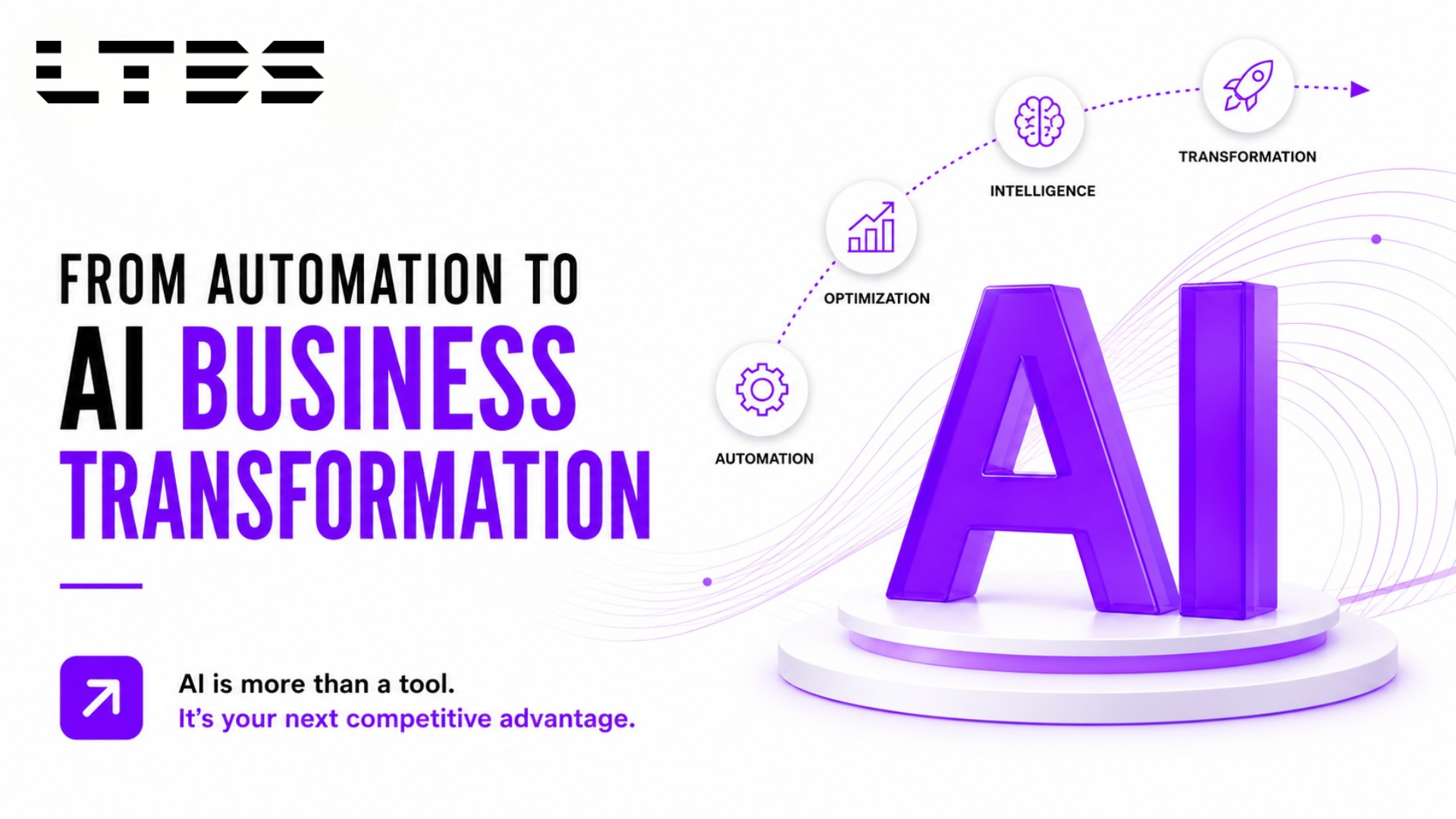
A few years ago, companies viewed artificial intelligence (AI) primarily as a tool for automating repetitive tasks. Today, that perspective has shifted toward AI business transformation.
Throughout history, as technology advances, it also sparked concerns about job displacement. From industrial machinery and factory automation to computers and software, each wave of innovation has raised questions about the future of work. Moreover, AI has intensified those concerns as it slowly progressed to being capable of generating content, analyzing data, automating workflows, and supporting decision-making.
Many people fear that technology could replace entire roles rather than simply assist with individual tasks. However, focusing solely on job replacement overlooks the bigger picture.
The businesses gaining the most value from AI aren't simply reducing manual work. They're transforming how they make decisions, serve customers, optimize operations, and create entirely new revenue opportunities.
Rather than using AI as a replacement for people, many businesses embrace the shift in AI wherein they are using it to augment human capabilities, improve business performance, and unlock new opportunities for growth.
At LTBS, we see AI as more than a tool for efficiency—it's a catalyst for business transformation. In this article, we'll explore how leading organizations are using AI to reshape decision-making, optimize operations, enhance customer experiences, and unlock new opportunities for growth.
What is AI Business Transformation?
AI business transformation is the process of using artificial intelligence to fundamentally improve how a company makes decisions, operates, serves customers, and creates value. Unlike basic automation, business transformation uses AI to drive innovation, revenue growth, and competitive advantage across the organization.
Why AI Business Transformation Is No Longer Just About Automation
The rise of AI is not new, it has been unfolding over the past two years, and we continue to see the rapid changes it brings. It reduces boring and repetitive human tasks, but many businesses still struggle with a lack of real-time data analytics, poor system integration that causes operational backlogs, and other inefficiencies.
These are just some examples of why businesses continue to operate on outdated systems. These challenges are not just operational, rather they directly impact revenue, growth, and market position. As a result, many business leaders across a diverse range of industries are now planning to adopt AI tools to upgrade their business processes.
AI adoption is becoming widespread. For many organizations, automation serves as the first step in their AI journey. AI-powered chatbots, content generation tools, workflow automation platforms, and data processing systems can reduce manual effort and improve efficiency. While these improvements deliver measurable benefits, they rarely create lasting differentiation making automation not an advantage, but it becomes the baseline for every company.
This is where AI business transformation differs from automation. Instead of focusing solely on completing existing tasks faster, transformation focuses on changing how the business operates, makes decisions, serves customers, and generates value.
The objective is not simply to improve productivity, but to build capabilities that competitors cannot easily copy. Take note, high-performing organizations do not treat AI as an efficiency lever alone; they prioritize growth, innovation, and strategic advantage, using AI to rewire core business functions rather than simply optimize them.
How AI Business Transformation Is Changing Decision-Making
One of the strengths of AI business transformation is that advanced AI solutions are now capable of strengthening decision-making in both business, and everyday life. It can process vast amounts of data, uncover patterns, detect behaviors, and identify anomalies that humans might miss.
As a result, AI now assists in recommending products, services, and actions that help teams make better decisions, and mostly, data-driven decisions. With AI, companies can shift toward asking better questions. Instead of asking, “What happened?”, they can become more proactive and focus on what comes next and what possibilities exist, enabling clearer choices and more effective actions.
One clear example of human error with a significant business impact is a Citigroup trading slip-up, where a fat-finger input mistakenly triggered a $444 billion order instead of $58 million. This led to a brief flash crash that wiped out as much as $322 billion in European market value at its peak, before being quickly reversed, and resulted in approximately $78 million in regulatory fines.
This example shows that humans and AI can work hand in hand in decision-making. AI enables teams to explore different perspectives and outcomes, helping them identify insights that human judgment alone might miss.
Additionally, Andrew Ng, Founder of Andrew Ng and Chairman of Landing AI, consistently emphasizes that organizations create the most value when AI becomes embedded in business workflows rather than existing as isolated technology projects. This means organizations achieve better outcomes when they redesign processes around AI capabilities instead of simply adding AI to existing systems.
How AI Business Transformation Is Reshaping Business Operations
Operational excellence has traditionally focused on standardization and efficiency. With the help of AI business transformation, businesses are moving toward intelligent operations, where instead of automating individual tasks, businesses optimize entire systems.
This includes predictive maintenance, where manufacturers use AI to identify equipment failures before they occur. Through AI business transformation, companies reduce downtime and maintenance costs while improving overall operational efficiency, allowing teams to focus more on growth and core business operations.
Next, AI business transformation improves inventory optimization, where retailers use AI to predict demand fluctuations and adjust inventory levels automatically. As a result, businesses reduce stockouts, lower carrying costs, and improve customer satisfaction. You understand when customers see product availability on a website and find it in stock, it increases conversion by turning interest into purchase.
Furthermore, organizations apply AI business transformation in workforce planning by forecasting staffing needs and optimizing resource allocation. AI assistants help automate repetitive tasks and streamline workflows by removing mundane, time-consuming duties from employees’ workloads.
By working with AI, businesses minimize operational backlogs and eliminate inefficiencies. Your employees gain immediate productivity improvements, gain more time to focus on innovation, and position both themselves and the organization for long-term success.
A company that redesign operational workflows around AI business transformation often generate greater returns than organizations that simply automate individual tasks.
How AI Business Transformation Is Redefining Customer Experience
You’ve experienced it as both a consumer and a business owner—customer expectations continue to rise. These expectations revolve around personalized recommendations, instant responses where customers expect 24/7 support when issues occur, consistent experiences across channels, and proactive support.
With AI business transformation, these capabilities are powered by machine learning (ML) and natural language processing (NLP), which enable AI systems to analyze inputs, understand context, and determine how best to support customers in real time.
AI business transformation enables organizations to deliver these experiences at scale, shifting from personalization to hyper-personalization. AI-powered systems analyze behavioral data, purchase history, intent signals, and engagement patterns, allowing businesses to deliver highly relevant experiences to individual customers.
In addition to that, Satya Nadella, CEO of Microsoft, identifies AI as a cognitive amplifier for work where he frequently discusses AI as a technology that amplifies human capability rather than simply replacing human effort. His leadership emphasizes integrating AI into productivity, collaboration, and customer engagement systems. Businesses that successfully deploy AI across the customer journey often achieve stronger retention rates and higher customer lifetime value.
How AI Business Transformation Is Enabling New Business Models
The most transformative organizations use AI business transformation not just to improve existing businesses, but to create new ones. This represents the highest level of AI maturity, and it includes the following examples:
- AI-Enabled Products: Software companies increasingly embed AI directly into their products.
- Outcome-Based Services: Organizations can offer guaranteed outcomes powered by predictive AI systems.
- Data Monetization: Businesses use AI to generate insights that become products themselves.
- AI Agents as Services: Many organizations are now deploying AI agents capable of managing workflows, generating content, handling customer interactions, and supporting business functions.

Industry analysts predict autonomous systems and AI agents will play a central role in future business models. Gartner describes this shift as the move toward autonomous business which means the next wave of AI leaders will not compete based on who has the most advanced models, but they will compete based on who redesigns their business model fastest around AI-enabled capabilities.
The advantage will come from execution, workflow redesign, and organizational learning, it does not simply adopt technology, but it will be participating in running them.
Challenges in AI Business Transformation
Despite its potential, AI business transformation is difficult to execute in practice. Many organizations adopt AI tools, but only a few successfully embed them into core business processes in a way that delivers sustained value.
Fragmented Data and Legacy Infrastructure Limit AI Readiness
Most enterprises still rely on legacy systems and siloed data structures that limit visibility across the organization. When data is fragmented or inconsistent, even advanced AI systems struggle to generate reliable outcomes. As a result, the foundation, not the model, often becomes the primary constraint to transformation.
Organizational Resistance Slows AI Adoption and Workflow Change
AI business transformation also requires significant organizational change. Employees may resist adoption when AI is introduced as a standalone tool rather than integrated into daily workflows. Remember, you must still see the value and prioritize human capabilities, rather than relying wholeheartedly with AI, because without clear alignment and leadership support, AI initiatives often remain isolated and fail to be optimized across the organization.
The Gap Between AI Tool Adoption and True Business Transformation
Many companies adopt AI applications but do not redesign underlying workflows. This creates an execution gap where AI improves efficiency at the surface level, but does not transform how the business operates. Organizations that succeed go beyond tool adoption and restructure processes around AI capabilities.
Governance, Risk, and Trust Become Critical
As AI becomes embedded in decision-making and operations, governance becomes critical. The NIST AI Risk Management Framework recommends structured approaches to AI governance, trustworthiness, and responsible deployment to ensure trust and long-term scalability.
Conclusion: The Shift from Automation to AI Business Transformation
AI is no longer simply a tool for automating tasks, it has become a catalyst for AI business transformation across decision-making, operations, customer experience, and business models. What began as a focus on efficiency has evolved into a broader shift where organizations redesign how they operate, compete, and create value.
Across industries, the most successful companies are not those that adopt AI the fastest, but those that integrate it deepest into their workflows. AI is no longer about automation alone, the strongest impact of AI business transformation is when AI is connected to the right systems, teams can recognize patterns, respond faster, and act before small issues become larger business.
AI is here to stay. It does not mean you should keep pushing it away or avoid engaging with it, because AI will continue to adapt, change, and evolve the way our world works. However, as a business, you must remember that AI business transformation is not about replacing human capability; it is about augmenting it. The organizations that recognize this shift early and act decisively will define the next era of competitive advantage.
AI business transformation is not about adopting more tools, it’s about rethinking how your business creates value. At LTBS, we work with teams to embed AI into core operations, improve decision-making, and build scalable competitive advantage.
Ready to move from automation to AI business transformation? Talk to LTBS today!