
The Rise of Agentic Shopping: How AI Commerce Is Changing eCommerce

Adam Baodunnov
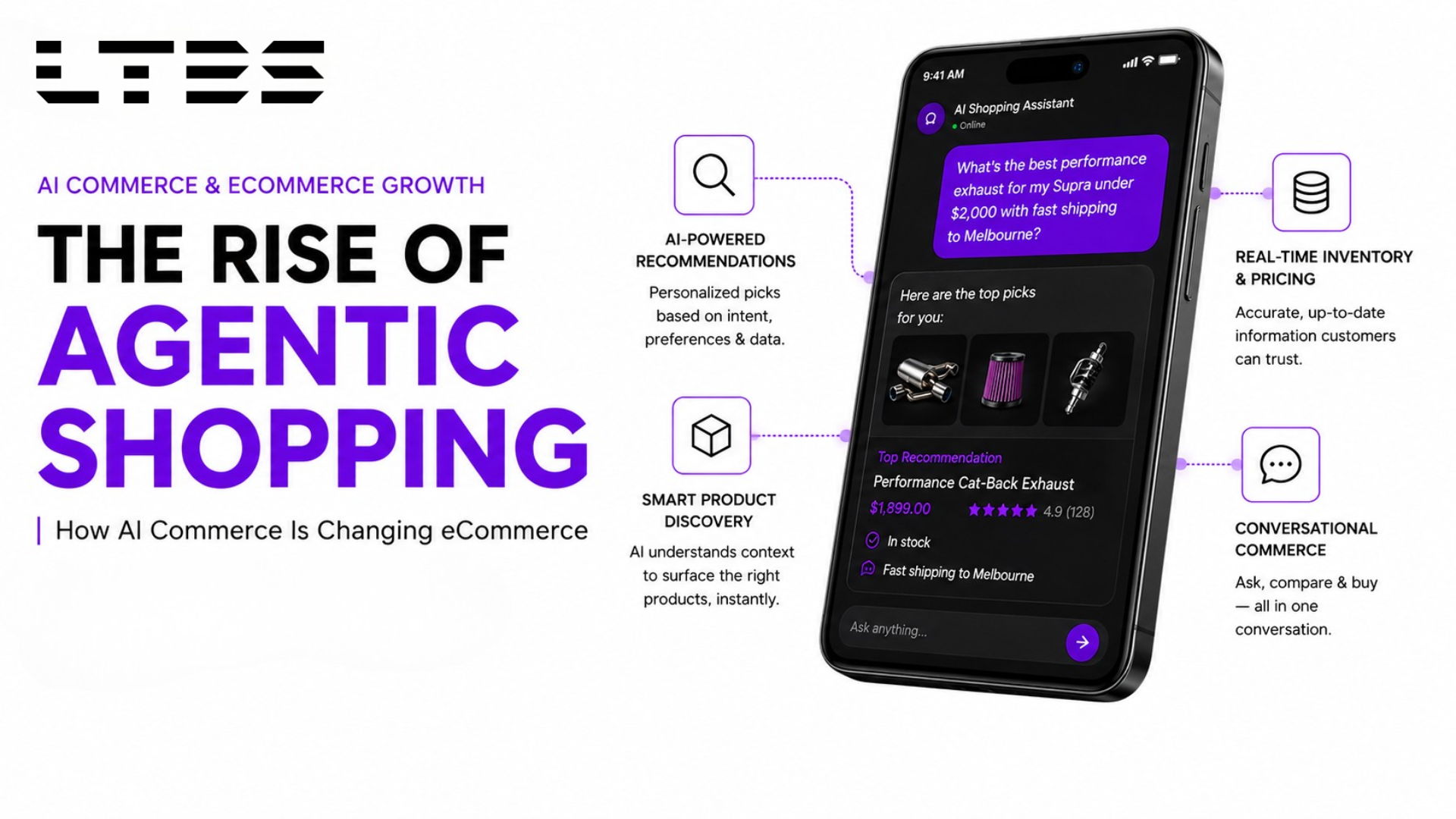
The Rise of Agentic Shopping & What It Means for Your Brand
Just like how fast the night changes, so is the way people shop and interact with brands. Back then, it was all about customer reviews and trust, but now new wave is coming—AI.
The eCommerce industry is entering a new era powered by AI where customers are no longer browsing dozens of product pages manually. Instead, with the help of AI-powered shopping assistants they are transforming how consumers discover, compare, and buy products online and this shift is called Agentic Shopping, which will reshape digital commerce over the next few years.
What Is Agentic Shopping?
Agentic shopping refers to AI systems that act on behalf of users during the shopping process. Instead of visiting multiple websites and comparing products manually, customers simply ask an AI assistant what they need.
The AI then analyzes product information, reviews, pricing, availability, and customer preferences before recommending the best options—creating a faster, smarter, and more personalized shopping experience.
As a result, major platforms including Shopify, Google, ChatGPT, Microsoft Copilot, and Gemini are actively building AI-driven shopping experiences that let customers receive recommendations and complete purchases through conversational interfaces.
For businesses, this means products must now be optimized not only for human users, but also for the AI systems that interpret and recommend them.
At LTBS, we help eCommerce businesses understand these changes and prepare their stores for the next generation of AI-powered commerce.
Why This Matters for Your Business
Traditional SEO strategies focused mainly on improving rankings on search engines like Google, but AI commerce introduces a new layer of competition.
Now businesses must also ensure their products can be understood, trusted, and recommended by AI shopping agents, which changes how online stores need to approach everything from product content to customer trust signals.
Businesses that fail to adapt may struggle to appear in AI-generated shopping recommendations. On the other hand, brands that optimize early will gain a strong competitive advantage, capturing visibility in a channel that is rapidly becoming the primary product discovery surface.
The following areas are affected by the AI-generated recommendations:
- Product Content
- Technical SEO
- Structured Data
- Product Feeds Customer Trust Signals
- Inventory Management
- Website Performance
Nowadays, brands that know how to adapt are the brands that win.
The Growing Role of Shopify in AI Commerce
Shopify has already started building solutions that support AI-powered commerce experiences. Through innovations like Agentic Storefronts and AI integrations, Shopify merchants are becoming more discoverable inside conversational AI platforms.
This means visibility is no longer limited to search engine rankings alone. The future of product discovery is becoming conversational and AI-driven. Customers can now:
- Discover products directly inside AI chats
- Compare products conversationally in real time
- Receive personalized shopping recommendations instantly
- Complete purchases without traditional browsing journeys
Search is also evolving in how queries are formed. Where someone once searched “aftermarket accessories in Australia,” they now ask “What are the best performance exhaust upgrades for a Toyota Supra under $2,000 with fast shipping to Melbourne?”—and AI handles the rest.
How to Prepare for Agentic Commerce
1. AI-Optimized Product Content
Generic product descriptions are no longer enough. AI shopping agents don’t just scan for keywords, they interpret meaning, context, and intent. Your product pages need to answer the questions a customer would actually ask out loud.
Take Mars Performance as an example. Instead of a product listing that simply reads “Cat-Back Exhaust System—Stainless Steel,” an AI-optimized version would read: “This cat-back exhaust system is built for Australian drivers looking to increase horsepower and exhaust note on a Toyota Supra or Nissan Skyline. Manufactured from 304 stainless steel, it fits models from 1998–2002, installs in under two hours, and is compliant with Australian road standards.”
That level of detail, fitment, compliance, install time, vehicle compatibility, is exactly what an AI agent evaluates when a customer asks: “What’s the best exhaust upgrade for my R34 Skyline that’s road legal in Victoria?”
Your product pages should include:
- Specific vehicle compatibility and fitment details
- Material quality and manufacturing standards
- Real-world performance outcomes (e.g. horsepower gains, fuel efficiency)
- Installation difficulty and time estimates
- Compliance notes relevant to your market (e.g. ADR compliance for Australian roads)
- Natural conversational language that mirrors how customers actually speak
2. Structured Data & Schema Markup
Schema markup is the technical layer that tells AI systems, and search engines are exactly what your content means. Without it, an AI agent has to guess whether a number on your page is a price, a product code, or a phone number. With it, every critical detail is labeled and machine-readable.
For an eCommerce store like Mars Performance, well-implemented schema allows an AI to instantly surface: the price of a specific cold air intake, whether it’s in stock, what vehicles it fits, its average customer rating, and estimated delivery time to a given postcode—all without a customer ever visiting the site.
Here are the key schema types every eCommerce store should implement:
- Product Schema: Name, SKU, description, brand, images.
- Offer Schema: Price, currency, availability, shipping options
- Review Schema: Aggregate rating, individual review count
- FAQ Schema: Common questions answered directly on the product page
- Breadcrumb Schema: Site structure for better AI and search navigation
- Vehicle Compatibility Markup: Critical for automotive stores, maps products to specific makes, models, and years
A practical example is if a customer asks ChatGPT “Does Mars Performance stock a cold air intake for a 2003 WRX STI that ships to Brisbane?” A schema markup is what allows the AI to pull a confident and accurate answer rather than a vague redirect.
3. Technical SEO Performance
AI shopping agents evaluate trustworthiness and crawlability before surfacing any product recommendation. A slow, broken, or poorly structured website signals unreliability, and AI systems will deprioritize it in favor of cleaner competitors.
Google’s own research shows that a one-second delay in mobile load time can reduce conversions by up to 20%. For AI agents that are evaluating dozens of sources simultaneously, a sluggish site is simply skipped.
Here are the key technical foundations to maintain:
- Core Web Vitals: Largest contentful paint under 2.5s, a cumulative layout shift below 0.1, and interaction to next paint under 200ms.
- Mobile performance: Over 60% of automotive parts searches in Australia now happen on mobile.
- Crawl efficiency: A clean XML sitemap, logical URL structure, and no orphaned pages ensures AI crawlers index your full catalogue.
- HTTPS security: A non-negotiable trust signal for both users and AI systems.
- Duplicate content resolution: Common in eCommerce stores with multiple product variants; duplicates confuse AI interpretation and dilute ranking signals.
- Broken link audits: Dead product pages or outdated category links signal an unmaintained store.
For Mars Performance specifically, with a large catalogue across multiple vehicle categories, technical SEO hygiene ensures that every product from brake kits to turbo kits is fully visible and accessible to AI crawlers at all times.
4. Conversational Search Optimization
The way people search has fundamentally changed. Voice search assistants, AI chatbots, and smart devices have trained consumers to ask full questions rather than type fragmented keywords. This shift demands a different approach to how product pages and supporting content are written.
Back then, the old search behavior goes like this: “performance exhaust Australia”. Now, new AI query searches like this, “What’s the best performance exhaust for a Mitsubishi Lancer Evo 9 that’s under $1,500 and available with same-week shipping in Sydney?”
These longer, intent-rich queries are where agentic shopping operates. To appear in AI recommendations, your content must match the language, specificity, and intent of how real customers ask questions.
Here are some strategies that work:
- Build an FAQ section on every major product page. Questions like “Will this fit a left-hand drive conversion?” or “Is this exhaust legal for track days in Queensland?” are exactly the queries AI agents are fielding.
- Create buying guide content. A page titled “How to Choose the Right Suspension Kit for Street vs. Track Use” helps position brands like Mars Performance as an authority and feeds AI systems with context-rich, recommendable content.
- Use natural language in product titles and descriptions. Instead of “SS-304 CBE Universal Fit,” write “304 Stainless Steel Cat-Back Exhaust: Universal Fit for Japanese Sports Cars.”
- Target semantic clusters, not just individual keywords. Content around “performance exhaust,” “exhaust note improvement,” “horsepower gains,” and “ADR-compliant exhaust upgrades” collectively signals topical authority to AI systems.
- Answer comparison questions. Customers ask AI agents to compare products. Pages or content that directly address “axle-back vs. cat-back exhaust, which is better for daily driving?” give AI agents ready-made and citable answers.
5. Real-Time Inventory & Product Data Accuracy
This is the point where many eCommerce stores quietly lose AI recommendations, not because their SEO is poor, but because their data is unreliable.
AI shopping agents are built to serve accurate answers. If your product feed shows an item as in stock when it isn’t, or lists a price that doesn’t match your checkout, the AI agent either surfaces a bad recommendation or more commonly learns to deprioritize your store entirely. Once trust is lost with an AI system, it is difficult to rebuild.
For a high-SKU store like Mars Performance, where inventory moves quickly and product fitment data is complex, data accuracy is a genuine competitive advantage.
What accurate product data looks like in practice:
- Live inventory sync: your website stock levels reflect your warehouse in real time, not on a 24-hour delay.
- Consistent pricing across all surfaces: your Google Shopping feed, your product page, and your checkout all show the same price
- Fitment data completeness: every product specifies the exact makes, models, years, and variants it is compatible with
- Clear shipping estimates: stating “ships within 2 business days to metro Australia” is far more useful to an AI agent than “fast shipping”
- Variant-level accuracy: if a specific colour or size is out of stock, that variant is marked unavailable, not hidden under a generic “out of stock” message on the parent product
When an AI agent asks your store’s data layer whether a specific Brembo brake kit is available for a 2005 Subaru WRX STI and can arrive in Melbourne by Friday, your systems should be able to answer that with confidence. Stores that can get recommended, and stores that can’t won’t.
The Future of Commerce Is Conversational
The next two to three years will determine which eCommerce brands own AI-driven product discovery, and which ones get bypassed entirely.
The shift is already underway. Shopify is building agentic storefronts. Google is embedding AI recommendations into search. ChatGPT and Gemini are being asked shopping questions millions of times a day. The customers are already there. The question is whether your store is visible to them when it matters.
Brands like Mars Performance, operating in a high-intent, research-driven category like automotive performance parts are particularly well-positioned to benefit from agentic commerce because customers in this space ask detailed and specific questions. They compare products carefully. They want trusted recommendations. That is precisely the environment where a well-optimized, data-accurate, content-rich store wins.
The brands that act early in building AI-ready content, implementing structured data, and optimizing for conversational search, are the ones that will dominate product discovery in this next era. It requires more than basic SEO. It takes technical depth, strategic content, and a commitment to data accuracy across every layer of your store.
The opportunity is significant. The window to act early is still open, but it won’t be for long.
How LTBS Helps Your Business Adapt
At LTBS, we work with ambitious eCommerce brands to build future-ready digital experiences that perform, not just on search engines, but inside the AI-driven platforms that are rapidly becoming the new storefront.
We’ve seen firsthand what separates brands that grow from brands that plateau. It comes down to strategy, execution, and the technical foundations that most agencies overlook. That’s where we come in.
Our expertise includes:
• eCommerce Growth Strategy & Consulting
• Shopify Store Development & Optimization
• SEO for Market Leadership
• Technical SEO Audits & Performance Fixes
• Website Speed & Core Web Vitals Optimization
• Structured Data & Schema Implementation
• Conversational & AI Search Optimization
• AI-Ready Product Content Creation
• Precision Search Marketing (Paid & Organic)
• Email Funnel Automation & Customer Retention
• Reputation Management & Media PR
AI is reshaping how customers discover, compare, and buy products online. Businesses that rely on yesterday’s SEO playbook will find themselves invisible to the next generation of shoppers. However, those that build the right foundations now from clean technical architecture, structured data, content that speaks to both humans and AI, will own that visibility.
Our goal is simple: help ambitious brands grow faster, scale smarter, and stay ahead of the curve, whether that means your first million in revenue or your next ten.
Connect with us now and let’s talk about how we can AI-optimize your business!