
Furniture Marketing Funnel Audit: 10 Things Every Aussie Brand Should Check Today

Adam Baoudunnov
Marketing Funnel Audit Checklist for Aussie Furniture Brands
Australia’s furniture industry is more competitive than ever. Inflation is tightening budgets, new brands are popping up everywhere, and shoppers are looking harder at sustainable, locally made pieces with real craftsmanship. It's hard out there, but that’s exactly why a marketing funnel audit matters right now.
Building a successful furniture business demands more than just creating furniture. It comes from a long way, especially if you’re doing it online. People don’t buy a sofa like how they buy snacks; they browse for weeks, compare, abandon their carts, return, ask people, seek reviews, and only then commit.
So, the question is: if your marketing funnel was a physical showroom, would customers find what they need, trust the quality, and make it to checkout without getting lost on the way?
In this guide, we’ll walk you through a clear marketing funnel audit checklist, covering ads, SEO, email, and CRO—so you can fix the leaks, tighten the journey, and win more customers who genuinely want what you sell.
Why Having a Furniture Marketing Strategy Matters
When your funnel doesn’t match how people actually shop, money leaks out in places you can’t spot by looking at one channel at a time. And for Australian furniture brands, this matters more than ever. Online now drives roughly a quarter to a third of furniture revenue in Australia, and that share keeps growing. In short: your digital funnel is your showroom.
Your website should be spectacular because Aussies shop for furniture online across multiple channels. Even if your pieces are great and durable, that alone isn’t enough to compete. Your online presence across channels, they become your digital showroom—it’s where you connect with customers and make sure the furniture you’re selling speaks to them, and they don’t just look good.
Having a smart furniture marketing strategy matters because it acts like your blueprint, making sure your brand shows up at the right moments and stays there until the customer is ready to commit. It helps you pinpoint who your customers are, what they’re looking for, the experiences they crave, and how to build relationships that lead to long-term engagement—and here’s how to get it rolling.
What a Furniture Marketing Funnel Looks Like
A typical furniture journey looks more like this:
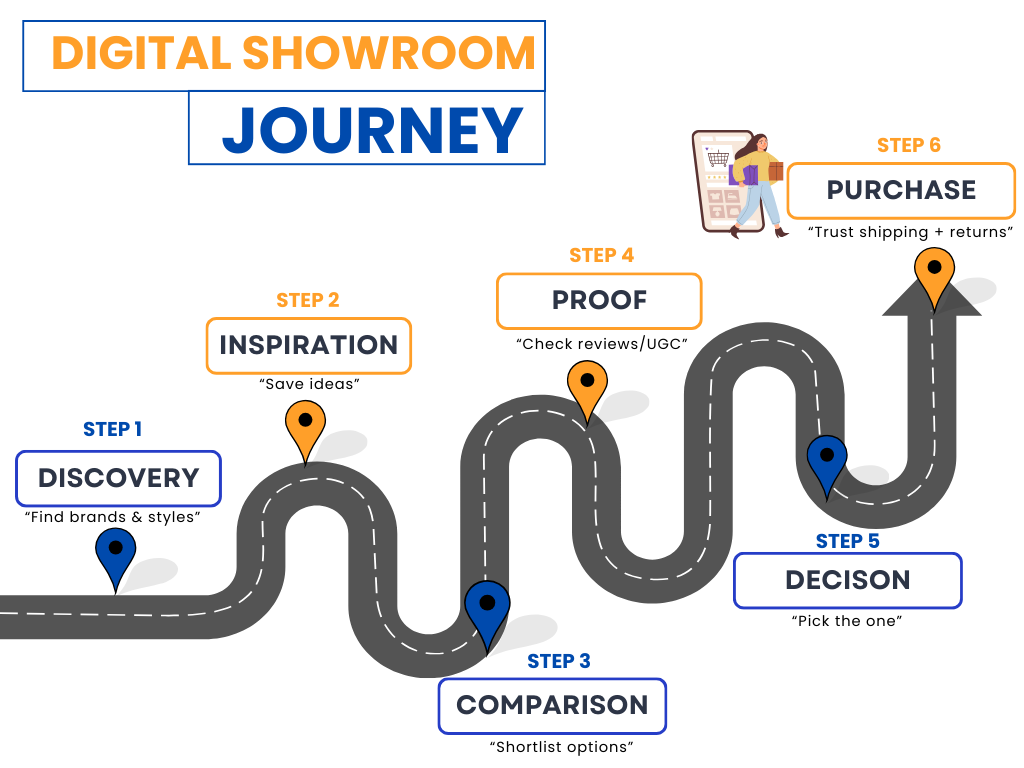
And your shopper might:
- find you via a “modern dining table Australia” search,
- You’re on save two options for later,
- come back after seeing a retargeting ad,
- check reviews and UGC,
- compare delivery timelines,
- then finally buy, but often on a different device.
It takes much longer for customers to buy because, aside from the fact that it’s mostly online, they can’t physically touch furniture to believe in every piece out there—and that’s also why they use reviews as their trust basis.
According to The Insiders, 68% of respondents said they would not purchase a product without a review. Additionally, around 26% of respondents are unsure about making a purchase.
So instead of asking “are our ads good?” or “is SEO working? ”The better question is: Does your funnel support how Australians actually shop for furniture in 2025?
Let’s audit it!
The 10 Funnel Audit Checkpoints
1. Ecommerce Traffic Audit for Furniture Brands: Paid, Organic, Social, Direct
Furniture is highly-considered, customers rarely convert at the first visit, unlike when you’re buying food. This is where the furniture business makes it wrong, they just build a single engine funnel, and they rely too heavily on one channel like PPC or organic search. When that channel’s performance drops, sales can tank unexpectedly and panic rises.
Here’s what you need to audit:
- Break down your traffic by channel: paid ads, organic search, social media, email, and direct visits. Look for the imbalance and if you find one channel that drives more than 50-60% of sessions, then you’re exposed.
- Check your Calculate Customer Acquisition Cost (CAC): for each channel and compare their revenue contribution because your best channel isn’t always the biggest, but it’s the one with blended efficiency.
- Separate branded vs non-branded organic traffic: branded traffic means people already know you, however, non-branded means growth. If your organic is mostly branded, you aren’t discovering new buyers.
- New vs Returning Visitors: Check whether they are new vs returning visitors by channel because paid often brings new users; email/direct brings returners, but truth is you need both, you need old customers for you to strengthen your credibility and trust that Australians consumers seek for.
The goal is to balance paid ads and seo because paid builds awareness and pulls in new audiences, while SEO captures intent consistently. Additionally, email directly brings shoppers back to finish decisions.
2) Furniture Paid Ads Audit
Furniture ads often look gorgeous and eye-catching, and that’s a good thing, but shoppers fall apart the second they land on your site. Ads create expectation, and your landing page should be the place they confirm everything is good, instead of doubting it or else shoppers lose trust and abandon.
Here’s what you need to audit:
- Message match: Does your ad promise from pricing, materials, delivery terms, and returns does it match landing pages? If your ad says “solid oak, ships in 3–5 days,” that exact promise should show above the fold.
- Creative match: Are shoppers seeing the same hero product, same vibe, same style collection?
- Device match: If 80%+ of ad clicks are mobile, your landing page must be built for mobile-optimized pages and not websites.
- Offer consistency: Are your promotions consistent all throughout the ad, landing page, and checkout journey.
Mismatch creates doubt. Retail doubt kills conversion. A good ad should be like this, when a shopper clicks an ad and thinks, “Yep, I’m in the right place. This is exactly what I expected.” Then you’re doing the right thing and avoiding retargeting.
3) Local SEO Audit for Australian Furniture Stores
People often search for “furniture near me.” They search by style, material, or location rather than brand names because every furniture shopper’s search begins broad and intent-rich:
- “bouclé sofa australia”
- “oak dining table sydney”
- “small condo dining set”
- “cloud sofa near me”
Non-brand SEO is how new customers find you. It’s also your cheapest long-term acquisition engine. The online furniture market in Australia is growing fast, so this visibility gap gets more expensive to ignore each year.
Here’s what you need to audit:
- Collection/category pages: Are they indexable, structured, and built around real search intent? Verify collection and category pages are crawlable and well-structured for SEO.
- Style/room/size clusters: Do you own style/ room/ size clusters, and they are not just product pages?
- Internal linking for authority: Do your strong blog/guide pages and internal links push SEO value through the funnel into high-margin collections?
- Local modifiers: Create and optimise showroom or location pages if you have physical stores. Having them makes it easier for shoppers to find you and for those pages to rank.
You rank for the research phrases customers use before they choose a store, and if you’re doing business, local SEO is the best way to strategize your business to grow online.
4) Furniture Product Page Audit
In furniture, the product detail page (PDP) is the make-or-break moment where interest turns into purchase or abandonment. This is important because you’re asking someone to buy something big, pricey, and hard to return and that is why your PDP needs to answer and remove fear for every customer.
Here’s what you need to audit:
- Real customer photos (not just studio): Include real customer photos and user generated contents alongside studio shots for authenticity.
- Show ratings + rating summary: Show review count and average rating prominently.
- Dimensions with context: Add room-fit guidance (“seats 3 comfortably,” “fits 6 dining chairs”).
- Materials + care + durability: Make your materials known, add care maintenance and instructions and address the wear, stains, scratches.
- Warranty/ returns clarity: Let them know about your warranty and returns policy.
- Delivery ETA above the fold: Show estimated delivery dates clearly above the fold, because making them known kills their anxiousness on the.
A good furniture marketing funnel is when your PDP answers every “what if?” before the shopper asks it. Furthermore, having a strong proof stack doesn’t just “inform” your customer, but it reduces the fear of your customers. Adding them adds confidence, credibility and trust, leading to an increase of your conversion.
5) Furniture Core Web Vitals Audit (Your Silent Conversion Killer)
Furniture sites are image-heavy by nature and if your website is slow it means you will lose customers no matter how good your products are because slow load times and layout shifts annoy users. That makes Core Web Vitals a revenue lever, not a tech detail. Google explicitly uses LCP, INP, and CLS as UX quality signals, and they correlate strongly with bounce and conversion outcomes.

Here’s what you need to audit:
- LCP (Largest Contentful Paint): How fast your main content loads. Slow LCP kills first impressions.
- INP (Interaction to Next Paint). How responsive your site feels when clicking filters, photos, dropdowns.
- CLS (Cumulative Layout Shift): Layout jumping on load means accidental clicks, trust loss.
- Template-level performance: Don’t just test the homepage. Test collections + PDPs + checkout on mobile.
Speed and accuracy helps your customer turn into conversion. You must prioritize speed on homepage, category pages, and PDPs, especially on mobile.
6) Furniture Site Search and Filter Audit
Your shopper arrives with flexible intent. They checked your website to explore, before deciding, and if discovery feels hard, they leave. So, your job is to help them narrow fast before they abandon their cart.
Here’s what you need to audit:
- Filter usage: Are your most-used filters visible and easy on mobile? Check filter usage rates, especially on mobile devices.
- Zero-result traps: Identify “dead-end” filters, if a filter combination leads to “0 items,” you just ended the journey.
- Internal search conversion rate: People who search on-site are high intent. If they don’t convert, the search is failing.
- “No results” recovery path: Offer alternatives like add intuitive discovery pathways like “shop by room,” “style,” or “size”, making sure there’s no dead ends.
What a good furniture funnel looks like is making your customers feel that discovery is like a guided showroom walk—effortless and enjoyable. It helps your customers find what fits their needs quickly, accelerating their decision, making every conversion faster.
7) Furniture Checkout Audit
Every high-value purchase like furniture makes checkout anxiety-prone. At checkout, shoppers want certainty like the total price, delivery timing, payment flexibility. And if you reduce the anxious part here, it improves conversions by lowering buyer hesitation.
Here’s what you need to audit:
- Shipping costs and delivery ETA timing: Are shipping costs revealed too late? You have to make sure to reveal the exact price and ETA of the product because every surprise cost from product to shipping causes abandonment.
- Guest checkout: Can shoppers check out as a guest? If yes, that’s a good thing, but if not, you have to add it now and never force account creation in a high-trust moment. Adding extra steps before purchasing the products annoys customers, and in return, they will abandon you.
- BNPL visibility and clarity: Are BNPL options available and easy to use? Double-check that your “Buy Now, Pay Later” (BNPL) options are obvious and easy, because they are widely used across AU retail and mostly expected in furniture—especially now that there are new BNPL compliance rules in 2025.
- Trust cues at checkout: Are delivery timeframes repeated at checkout? Now is the time to reiterate delivery timeframes, returns, and warranties at checkout.
Checkout is where trust becomes a transaction. Don’t make your customers think here or else abandonment is the answer.
8) Furniture Email Marketing Audit
Furniture purchase cycles can be long, but thankfully, email nurture is about guiding decisions and not just discount blasts. Email is your best low-cost way to guide them back and help them make decisions:
Here’s what you need to audit:
- Browse abandon flow: Check browse and cart abandonment flow timing.
- Cart abandon timing: First reminder fast, second reminder with proof, third with urgency.
- Post-view triggers: “Still deciding?” emails with reviews, care tips, delivery info.
- Segmentation by intent: Guide them by room/style/price range or repeated category browsing.
- Reassurance sequences: Show them reviews, contents that would help them, maintenance care, deliveries, and warranties.
If you effectively nurture your customers through emails, and don't only show up as discounts offer, you’re making sure your brand is top-of-mind and showcase your supporting their decision-making over time.
9) Furniture Retargeting Audit (Not Just Noise)
Generic retargeting ads cause ad fatigue and annoyance and that’s because most furniture retargeting is lazy with the same products, same discount, and same frequency. Every retargeting should support the research journey instead of driving them away.
Here’s what you need to audit:
- Are retargeting creatives tied to the funnel stage? Inspiration ads for lookbooks and room styling. Do you have proof ads for reviews and ugc for comparers? And decision ads for urgency buyers that are ready to convert.
- Dynamic product vs lifestyle sets: PDP retargeting alone isn’t enough, you need intent-widening creativity too.
- Frequency caps: Set frequency caps to prevent overexposure because too many ads are equal to fatigue and brand annoyance.
Every ad should feel timely and relevant, and most importantly not repetitive. After all, retargeting should feel like help and not harassment.
10) GA4 Funnel Tracking Audit for Furniture
If your data is murky, every optimization becomes a guess because data drives optimization but only if it’s accurate and clear.

Here’s what you need to audit:
- GA4 events for key actions: Have you set up GA4 events from product views, filter use, add-to-cart, begin checkout, form or quote submissions (if you use them).
- Marketing Efficiency Ratio (MER): Calculate your MER by channel and attribute assisted conversions from email or organic search.
- One clear dashboard: Do you have a dashboard where you can visualize traffic from PDP → add-to-cart → checkout → purchase stages.
Once measurement is clean, improvement is fast because reliable data helps identify leaks and guides effective improvements fast.
Polish Your Furniture Sales with LTBS
A successful furniture marketing strategy in Australia should be consistent, measurable, and focused on the customer experience. Do you want to become the furniture store shoppers look for first? Let’s make your pieces the ones they search for.
That modern or cloud sofa you posted on Instagram? Picture your prospective customer, Sophia, spotting it while scrolling, falling in love, and searching for it straight away. She types “modern sofa” or “cloud sofa” into Google, and your product appears—because your content, pages, and inventory connect behind the scenes. She clicks through, sees it’s available, checks the details, and knows she can buy it now.
Instead of hunting around or messaging multiple stores, Sophia moves from “I want that” to “I’m buying it,” because your funnel makes the path clear, fast, and confidence-building.
As your strategic growth partner, at LTBS, we help you clarify your audience, set accurate expectations, stay visible at every stage, and align ads, SEO, email, and CRO into one trust-building funnel that drives sales. When you connect your products and services across all channels, you build a furniture marketing strategy that works for your customers and delivers real growth for you.
Ready to round out your furniture marketing strategy and win more high-intent buyers? Book a Funnel Audit with LTBS today, and we’ll help you find the leaks, tighten the journey, and turn more browsers into customers.