
Beyond Automation: The Real Role of AI in Business

Why the biggest AI returns come from rethinking how a business runs, not from doing the same work faster.
If you ask most companies why they invested in AI, the answer still comes back to speed. Faster ticket resolution. Faster reporting. Faster first drafts. Automation was the easy entry point, and for good reason, we understand it since it is visible, it is measurable, and it pays for itself quickly.
But efficiency is just the warm-up act, not the main event. Reducing the time a task takes does not change what the business is capable of. It just makes the old way of working slightly cheaper.
The organizations pulling ahead right now are using AI for something different: rethinking how decisions get made, how customers are served, and how the business is shaped, not just how quickly existing tasks get done. That distinction, automation versus transformation is what we are going to talk about.
Two Different Layers of AI Value
Let’s think of AI's impact on a business in two layers, but they are not competing approaches. Most companies move through the first to reach the second, but they create very different kinds of value.
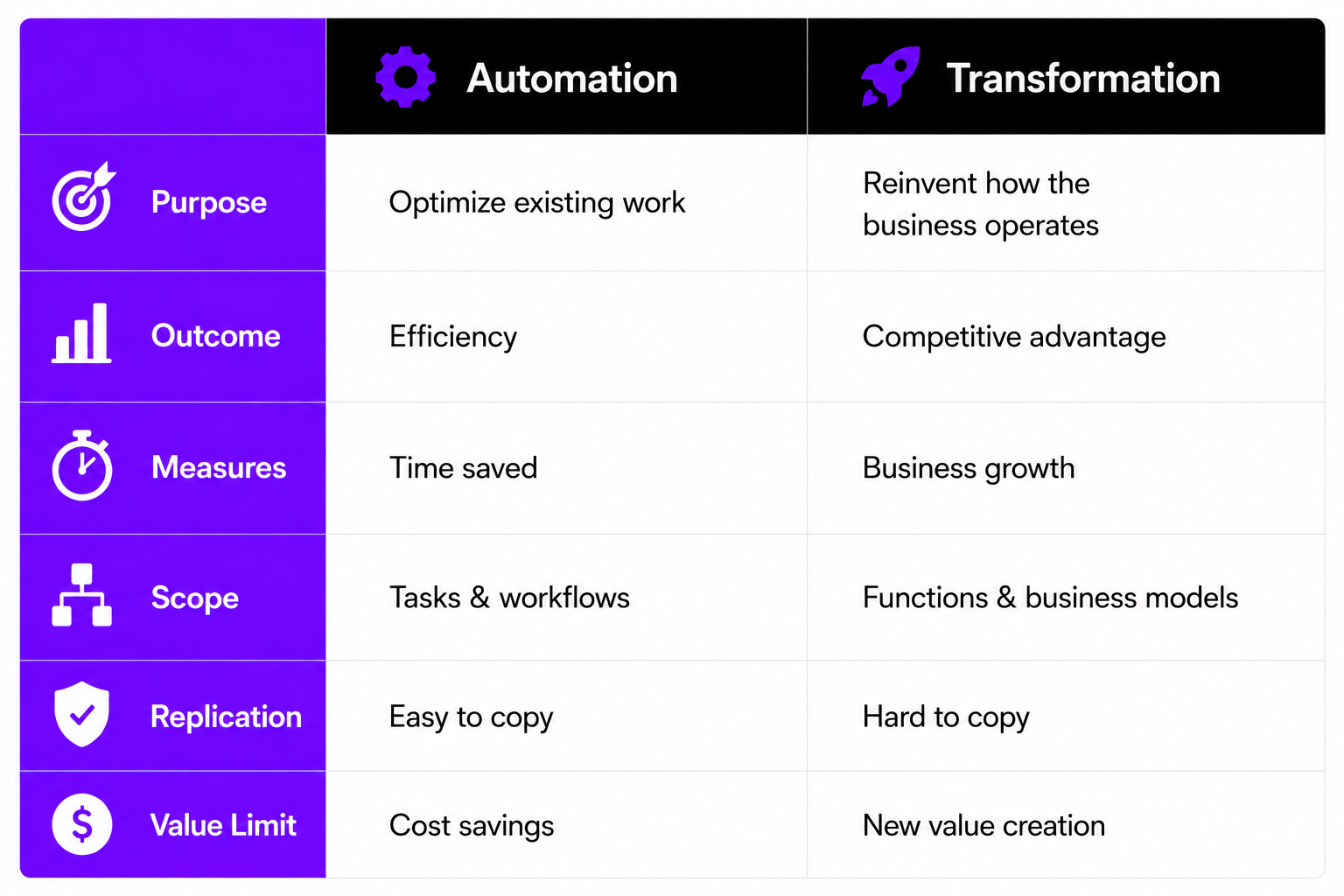
Take note, neither layer is wrong since automation is usually the first and necessary step when doing AI business transformation. However, with a transformation layer, it builds the data habits, the trust, and the internal case for going further. The mistake is stopping there and assuming the job is done.
From Reporting the Past to Shaping What's Next
Most business reporting answers one question: what happened? Dashboards, monthly reviews, and quarterly summaries are built to describe history accurately. They are rarely built to tell you what to do about it.
AI changes the shape of that question. Instead of waiting for a human analyst to notice a pattern across thousands of transactions, support tickets, or supply chain signals, a model can surface it as it forms and increasingly, can model out what happens next under different choices.
What this looks like in practice
- Scenario modeling: a pricing team testing the revenue impact of a discount before it ships, instead of reviewing it a quarter later;
- Early signal detection: a model flagging a vendor whose delivery pattern resembles past disruptions, before the disruption happens;
- Decision support at every level: frontline staff and executives working from the same live view of demand, risk, or customer sentiment, instead of reconciling separate spreadsheets.
The shift is from descriptive to anticipatory. That is a genuinely different operating posture for a business and not a faster version of the old one.
Operations: From Isolated Fixes to a Connected System
Automation tasks typically target one task at a time, auto-generate the invoice, auto-route the ticket, auto-fill the form. Each fix is real, but it lives inside a larger process that often stays just as fragmented as before.
Transformation treats the operation as one connected system. When inventory data, demand forecasting, staffing, and supplier communication all feed the same model, a change in one area —a spike in demand, a late shipment which can ripple through a coordinated response instead of waiting to be discovered department by department.
Three operational shifts worth watching
- Predictive maintenance: equipment and infrastructure issues are flagged before failure and not after.
- Dynamic inventory: stock levels adjust to real demand signals instead of fixed reorder points.
- Adaptive resourcing: staffing and resources shift toward where the data shows they're needed, ahead of the bottleneck rather than in response to it.
The common thread is timing. These are not new tasks; they are old problems caught earlier, with enough lead time to actually change the outcome.
Customer Experience: From Faster Service to Earned Relevance
According to Gartner, AI assistants are set to emerge and make even more human-based tasks easier, and custom AI models will become more popular to help businesses tailor intelligence to their specific needs. By 2027, chatbots will become the primary customer service channel for roughly a quarter of organisations.
As of today, many businesses and organizations are incorporating chatbots and auto-responders to make support faster. That was the automation phase, and customers noticed. However, there are points where it mostly goes wrong. A bot that answers quickly but misunderstands the question does not feel like progress.
Here comes the transformation phase where it’s about relevance and not speed. When a system understands a customer's history, intent, and context well enough to anticipate what they need, not just respond to what they typed, service stops feeling automated at all. It feels attentive.
AI is best understood as a cognitive amplifier — something that extends human capability rather than replacing it. — a framing echoed by technology leaders across the industry
That amplifying effect is most visible in customer experience. The businesses doing this well are not removing people from the relationship; they are giving the people in that relationship. Support agents, account managers, marketers, a far clearer picture of who they are talking to and what would actually help.
The Furthest Step: AI Changes What a Business Sells
The most advanced use of AI does not improve an existing process at all, it creates a new one. This is the point where AI stops being infrastructure and starts being part of the offer itself.
- Embedded AI products: software that ships with built-in intelligence as a core feature and not an add-on.
- Outcome-based pricing: contracts priced on the result delivered, made viable because predictive models can reliably forecast that result.
- Insight as a product: operational data, refined into insight, sold as a product in its own right.
- AI-delivered services: AI systems that handle entire workflows, not as a feature inside a product, but as the service being sold.
Few companies operate here yet, and that is precisely the point. This is where competitive advantage is hardest to copy, because it is not a tool a competitor can purchase, it is a business model a competitor has to rebuild from scratch.
Why Most Companies Stop at Automation
If transformation is so much more valuable, why do most organizations stop short of it? Four reasons come up consistently.
First, the data isn't ready. Since transformation depends on clean, connected, trustworthy data. Many companies are still running on systems that do not talk to each other, which means even a capable model is working with an incomplete picture.
Next, the org chart resists it. A tool that helps someone do their existing job faster is easy to accept. A system that changes how decisions get made, and who gets to make them meet resistance, especially without clear leadership backing.
Additionally, tools get adopted, but workflows don't get redesigned. This is the most common gap. A company licenses AI software, technically 'has AI,' and changes nothing about how work actually flows. The tool sits on top of the old process instead of replacing it.
Lastly, governance lags ambition. As AI starts influencing real decisions, questions of accuracy, accountability, and oversight stop being theoretical. Companies that scale AI without scaling governance alongside it tend to hit a trust problem before they hit a technical one.
Where to Start?
Transformation does not require abandoning automation, it requires not stopping there. A reasonable path looks like this:
- Pick one decision: Identify one decision your business makes repeatedly and currently makes on incomplete or outdated information.
- Audit the data behind it: You cannot transform a process built on three disconnected spreadsheets, you have to fix the issue first, from then on, you can move forward.
- Redesign the workflow around the model: Don't just plug a tool into the old steps, ask which steps the tool makes unnecessary.
- Build the governance at the same time as the capability: Decide who reviews the AI's output, how errors get caught, and who is accountable for the result.
- Expand from a proven example: A single well-redesigned process teaches the organization more than ten bolted-on tools ever will.
The Real Question to Ask
Automation answers a narrow question: how do we do this task for less? Transformation answers a bigger one: should we still be doing this task the same way at all?
That second question is uncomfortable, because it can mean redesigning a process, a team structure, or even part of the business model. It is also where the lasting advantage sits. Efficiency gains get matched by competitors within a budget cycle. A genuinely redesigned operation, decision process, or customer relationship is much harder to copy because copying it means rebuilding how the company works, not just buying the same software.
The companies that treat AI as a faster version of the status quo will keep getting faster versions of the status quo. The ones asking what becomes possible, not just what becomes quicker are the ones setting the pace for everyone else.
Remember, AI is here to stay and businesses that adapt early will have a significant advantage over those that wait.
If you're unsure whether your business is ready for AI transformation, LTBS can help you assess your current systems, workflows, and digital foundation.
✅ Discover your AI readiness
✅ Identify automation and growth opportunities
✅ Get expert guidance on where to start
Book a call today and receive a FREE website audit!