
2025 Australian Furniture Buying Trends: Value, Trust Signals & Sale Seasons

Adam Baodunnov

Australian Furniture Shopping Trends 2025: What Buyers Want Now
Before this year ends, isn’t it better to identify the Australian furniture shopping trends 2025 one last time, analyze them clearly, and get ourselves fully ready to win in 2026 again, with confidence, and not guesswork?
Let’s be real here: even though the cost of living impacts Australian shoppers, it hasn’t turned furniture shoppers into reckless bargain chasers. If anything, it has made them sharper, and they now know what they want and what they value.
So, how do we stay ahead of these evolving demands? And in the furniture industry, where there are many options available, how do you stand out from the crowd?
LTBS is here to help. We will break down what they want, what they avoid, where they buy, and how furniture brands can win trust and conversion in this new value-first market.
Turn Your Browsers Into Shoppers
We’re all about connecting brands and customers with one another because we want to make every shopping experience smooth sailing. We’re here to help you meet your targets and drive profitable growth by delivering shoppable furniture content that sells, SEO, and performance systems that turn high-intent browsers into buyers by aligning your marketing with how Australians actually shop. We’ve got growth solutions to help you improve your business end-to-end marketing campaigns, help you stand out, and create a shopping experience that turns browsers into customers.
Just turn on LTBS’s marketing solutions today. Visit: ltbsm.com
Setting the Scene: The New Definition of “Value” in 2025
We’ve seen the impact of the cost-of-living crisis from rising inflation, increasing interest rates, and the global economy, which significantly impact Australian businesses and consumer spending, creating challenges for both. As a result, businesses are adapting to changing consumer behaviour, managing operational costs, and navigating an increasingly competitive furniture market.
Even with these headwinds, the furniture retail market is still expanding. IMARC Group reports that Australia’s furniture retail market was worth USD 10.87B in 2024 and is projected to grow to USD 18.68B by 2033, representing a 5.6% CAGR from 2025-2033.
That growth doesn’t mean shoppers are spending carelessly. Australians have become more price-sensitive and value-driven, especially when scrolling online. Shoppers now navigate every purchase with one question in mind: what offers the best value?, or is it worth buying for?
Affordable and cheap are no longer synonyms. Price, value, durability, lifespan, warranties, delivery reliability, reviews, recommendations, locally made cues, sustainable furniture materials, and real photos all matter—so if your brand isn’t offering one of these, shoppers will scroll past you.
You’ve likely seen this shift yourself: shoppers now apply “cost per year” thinking. They’d rather buy once and keep it for years than replace a cheaper piece every season, because longevity is what makes a purchase truly good value.
The 2025 Buyer Checklist: What Matters Most
Australian furniture shoppers run a fast but strict checklist before they commit. Value is still the entry point, but they now define it as fair price with quality-driven assurance, and definitely not just the cheapest option.
The online buying behaviour of Aussies shows up most clearly online, where shoppers compare options quickly, verify quality through proof, and only buy when the deal feels legitimate.
In that way, “to see is to believe” now carries more weight than third-party verifications or trust seals since shoppers don’t grant trust because a brand claims it—they grant it when real people validate it through visible proof. Australians want volume, visuals, and specifics, so here’s the checklist they typically run before buying.
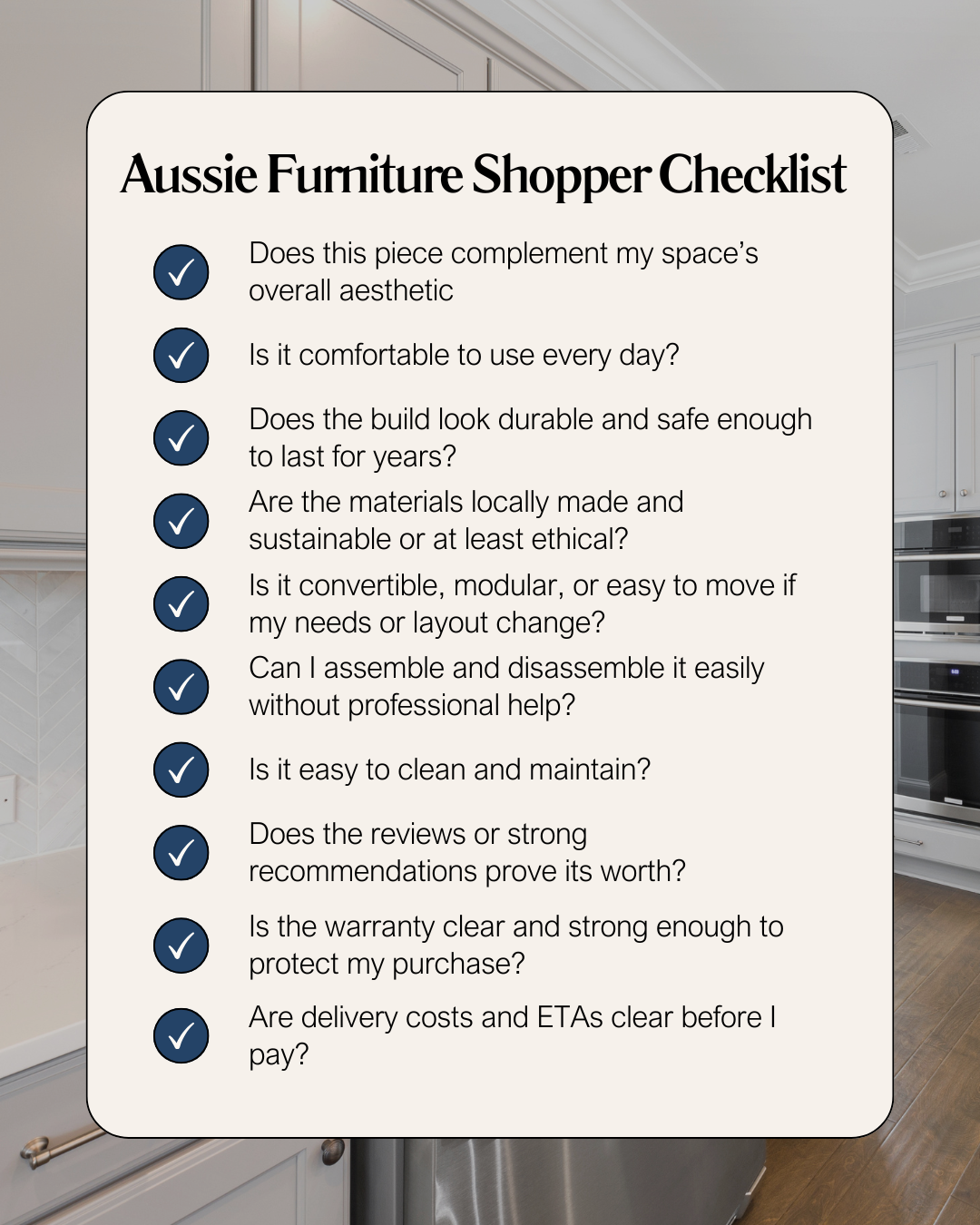
These checklists are where Aussies rely whether a product feels worth it. But timing is an additional factor when Aussies buy, and in 2025, sale seasons drive that timing.
Sale Season Events in Australia 2025
Australians are motivated by direct financial incentives, especially in the furniture industry because high-ticket purchases push shoppers to look for free shipping, discount codes, or time-bound promos before they commit. But brands need to run these offers strategically, or else, discounts and continuous sales lowers trust in both your product and your brand.
In 2025, sale seasons shape not only what Australians buy, but when they buy. Shoppers wait for promos, build wishlists, and compare three to five retailers before they pull the trigger. That behaviour makes EOFY, Black Friday, Cyber Monday, and Boxing Day core buying windows in Australian furniture shopping trends.
Best Time to Have Furniture Sales in Australia
January
Every consumer has this “new year, new me” thinking, which is why January is widely regarded as an excellent time to run furniture sales in Australia. After the busy holiday season, businesses tend to extend their sales, and discounts during this time can range from 20% to 50%, offering considerable savings.
Additionally, this period feels like a fresh start, which is why consumers are still in a splurging moment. They are motivated by holiday traditions, or simply by the tradition of starting the year with brand-new furniture that helps them feel set up for a better life in the new year.
End of Financial Year (EOFY) Sales (June/July):
Every business anticipates this as one of the biggest retail events in Australia. Retailers aim to clear their inventory before the new financial year begins on July 1, creating significant opportunities for consumers to save, with strong furniture discounts often sitting in the 20% to 50% range. This is the time when you’re not trying to convince people to buy; you’re capturing demand that already exists because EOFY has become a planned buying ritual.
Black Friday Sale
With growing participation and record spending, furniture shoppers are increasingly timing big-ticket buys to this window. Black Friday now runs as a longer campaign, stretching from early Black Friday offers through Black Friday weekend, Cyber Monday, and into early December.
Many shoppers purposely delayed their shopping to specifically buy during this period because they benefit from wider stock and longer deal windows than later clearance events, making Black Friday one of the most reliable times to secure strong value on big-ticket pieces.
Boxing Day
For others, Christmas holiday sales are the waiting moment, but for Aussies, it’s Boxing Day. Boxing Day delivers a guaranteed surge in spending because you’re selling into a market that is already primed to buy, and conversion rates and average order values typically lift as shoppers expect to purchase during this window.
Australian shoppers also treat Boxing Day as a planned clearance opportunity. Reporting shows consumer intent for Boxing Day shopping remains high despite cost-of-living pressure, and media coverage frames it as a core “bargain week” ritual—meaning shoppers are willing to spend, especially on furniture.
What Peak Sale Seasons Mean for Furniture Brands
As a furniture business, peak sale seasons give you the best opportunity to run promotions strategically and stand out in a crowded market. Shoppers spend more during these windows because they believe they’re seeing the lowest prices they’ll get all year. Take advantage of these periods because shoppers enter with intent already formed which is to buy and spend.
Which is also why you need to show up ahead of the event through SEO, social proof, remarketing, and social media, so you capture demand at the moment it peaks instead of scrambling to create it last-minute.
Australians still compare three to five retailers side by side during peaks. If your offer looks legitimate and your trust signals are strong through reviews, delivery clarity, warranty, and maintenance, you can win without being the cheapest.
Furthermore, peak seasons also let you pre-select hero SKUs, manage inventory, and design discount depth strategically instead of racing competitors into margin death, and they give you the lead time to lock in carrier capacity, set realistic delivery windows, and prevent WISMO blowouts before they start.
When you run sales well in these periods, you create a halo for the rest of the year through repeat purchases and referrals after the event.
Why Trust Signals Matter More Than Ever
This 2025, Australians don’t shop like optimistic browsers, they shop like risk managers. The cost-of-living squeeze has made people more value-driven, but the bigger shift is risk sensitivity. Furniture is a high-ticket, high-friction category, so when trust drops, conversions die. And trust is dropping fast in the online market.
Recently, Australian regulators warned consumers about ghost stores where overseas sites are posing as local Aussie brands, running fake clearance sales, and disappearing after purchase. The ACCC reported a sharp rise in these sites and hundreds of complaints in 2025 alone, with the issue becoming more sophisticated and harder for shoppers to spot.
At the same time, online shopping scams are surging overall. Australians reported nearly losing $260M in shopping scams in the first nine months of 2025, a clear signal that shoppers are right to be cautious.
So if anything about your offer feels off, they bounce before they even reach price comparison. Which is why trust signals matter more than ever because of this environment, Australians now treat trust like a checklist item.
The Trust Filters Aussies Use Before Buying
Before committing, Australians check these to look for proof that the product is real, the brand is credible, and most importantly, the risk is low. The signals they rely most are:
- Real reviews and ratings platforms: They check the reviews on platforms like Google, ProductReview, Trustpilot, and similar.
- Customer photos and UGC: Shoppers check the furniture if it's real and usable in real homes, not just styled studio shots.
- Australian presence: Some Aussies check for a visible ABN, physical address, local customer support, and a real showroom if the brand claims to have one.
- Straightforward returns and warranty details: Shoppers double-check if they can find them immediately, without digging or emailing.
- Secure checkout cues and familiar payment options: If a brand accepts certain payment methods, it confirms the site is safe and established.
The rule is simple: if they can’t verify you fast, they won’t wait and see.
How Furniture Brands Can Win the Value-Detective Shopper
Impulse buying is something you won’t hear in the furniture industry. Around 72% of consumers prioritise price competitiveness and product quality which now sit as the top two decision drivers, and shoppers switch brands quickly when value isn’t obvious.
They buy with intent, when the product proves it’s worth it, and the brand proves it’s real. If you want to win this shopper, you need to do three things consistently: make value obvious, make trust instant, and make peak-season buying feel safe.
1. Show “Worth-It” Furniture Value Fast
Your biggest competitor isn’t another brand, it’s doubt. The 2025 shopper decides fast whether a product feels “worth it,” so your job is to remove guesswork early.
If shoppers can’t see the value quickly, they assume there isn’t any. So you have to show its value and not just claiming it:
- Show materials and build proof: Don’t just say “premium” or “high quality.” Explain why on the product description page (PDP) by detailing the materials, construction, and real-world benefits instead of stacking adjectives.
- Use comparisons strategically: Help shoppers see the trade-offs between your product and cheaper alternatives. When they can justify the price themselves, they convert faster.
- Surface “cost per year” value: Spell out lifespan, durability, and warranty coverage directly on the PDP, especially for big-ticket pieces like sofas, dining sets, and beds.
- Highlight practical lifestyle wins: Make comfort, easy-care finishes, space-smart features, and longevity scannable, because these factors outweigh style alone for 2025 buyers.
2. Make Trust Instant for Online Furniture Buyers in Australia
In furniture, trust is not a layer you add later—it’s part of the product and brand. Aussie treat online furniture shopping as a risk decision first. If they can’t verify your credibility quickly, they don’t proceed to cart.
To make trust immediate:
- Put reviews where the decision happens: Show real ratings and written reviews on category pages, PDPs, and sale pages, and not hidden tabs.
- Prioritise real-home UGC: Use customer photos and show the furniture in actual spaces so buyers can validate scale, finish, and comfort.
- Respond to negative reviews transparently: Aussies don’t automatically leave after a bad review—they dig deeper. Use that moment to prove credibility.
- Surface your Australian presence: Show ABN, address, local support details, showroom evidence if claimed.
- State returns and warranty clearly: Australian Consumer Law makes guarantees automatic; spell out warranty/returns in plain English so buyers feel protected.
- Make checkout feel safe: Familiar payment methods and clean UX reduce drop-off at the last step.
3. Use Sustainability As A Value Signal and Not A Slogan
Sustainable and eco-friendly furniture demand is rising in Australia, with consumers actively seeking recycled/ethical materials and low-impact finishes. However, you must take note that they want to know if your product is sustainable or ethically XXX.
What to do:
- Be specific about materials and sourcing: Claiming your product as sustainable without evidence reads like greenwashing.
- Tie sustainability to longevity: The value-detective shopper likes sustainability because it also means fewer replacements and lower lifetime cost.
4. Win Peak Sale Seasons Without Eroding Brand Value
Peak seasons are conversion gold in Australia, but only if you treat them as planned value events, not panic discounts. During peak seasons you should amplify your brand, not dilute it. The brands that win in 2025 don’t just discount harder, they prove value harder, make buying feel safe, and deliver on the promise after checkout.
- Pre-select hero SKUs and plan discounts: Avoid blanket markdowns that train customers to wait forever.
- Keep specs and reviews beside sale prices: Trust cues must sit next to the deal.
- Protect delivery confidence: Peak seasons spike and WISMO tickets are waiting if you don’t act proactively well, so set realistic ETAs and communicate early with your consumers.
Australian furniture shoppers in 2025 are not chasing the cheapest option—they’re chasing the safest and smartest value. They are driven by clarity, and not just through persuasion. They buy when three things line up: the product proves it’s worth the price, the brand proves it’s legitimate, and the timing feels right. That’s why “value” now means fair price plus confidence, why trust proof matters more than brand claims, and why EOFY, Black Friday, and Boxing Day remain the highest-intent windows to convert demand.
Your 2026 Furniture Growth Plan Starts Here
Do you want your browsers to turn into customers? Do you want to make your presence stronger during peak season? Do you want your customers to choose your furniture, especially when they want something worth the value of their money?
What are you waiting for? LTBS is your strategic growth partner in this digital marketing world, and we know exactly how Australians shop for furniture and how to turn that behaviour into profitable growth.
If you want to win that market, you need a system, and definitely, not a guesswork. LTBS is here to help you build those systems for your furniture brands that want to scale profitably in Australia. Let’s turn what buyers demand in 2025 into your growth advantage for 2026.
Be the brand Aussies choose first!